A backlink is a link from a page on another website to a page on yours. The definition is simple. Judging the link is not. Ten links can represent ten independent recommendations, ten copies of the same sitewide footer, or ten rows created by a spam network. A backlink count alone cannot tell you which situation you have.
Checked on July 10, 2026, Google's link guidance says links help it find new pages and act as a relevance signal. Google's ranking systems guide also says link analysis systems, including an evolved form of PageRank, remain part of its core systems. Bing's current webmaster guidelines take the same practical line: earned links can help, while artificial promotion and link schemes violate its rules.
At MAXUOD Digital, we treat a backlink as evidence with two audiences. A crawler can use it to discover and interpret a page. A person can use it to visit, compare, and enquire. The best link opportunities make sense for both. That is a better starting point than chasing a score or buying a promised number of links.
The short answer
A useful backlink usually comes from a relevant page, appears for a reason an editor or site owner can explain, uses context that fits the destination, and points to a page that deserves the visit. The referring website does not need to be famous. A respected local association, supplier, trade publication, university resource, or community organization can be more useful to a Halifax business than a generic high-score site with no connection to the market.
| Common shortcut | What it misses | Better decision |
|---|---|---|
| More backlinks are always better. | One domain can create thousands of repeated links. Quantity does not show editorial value or relevance. | Review referring domains, source pages, target pages, placement, and referral visits. |
| Only follow links matter. | A qualified link can still send customers, support discovery, and confirm a public relationship. | Understand the link attribute and the business reason before judging it. |
| Every .ca link is valuable in Canada. | A country-code domain does not make an irrelevant or manipulative page useful. | Prioritize Canadian sources when audience, subject, location, and editorial context also fit. |
| A high DR or Authority Score proves quality. | These are proprietary vendor metrics, not Google scores. | Use them for comparison, then inspect the actual page and relationship. |
The five parts of a backlink
A normal text link is an HTML anchor element. In simplified form, it looks like this:
<a href="https://www.maxuod.com/seo-halifax">Halifax SEO services</a>
That one line contains several decisions. The source page hosts the link. The href identifies the destination. The visible anchor text describes the destination. The surrounding paragraph supplies context. An optional rel value can qualify the relationship as sponsored, user generated, or nofollow.
Keep four related terms separate:
- A backlink is an inbound link from an external page to your page.
- A referring page is the exact page where that link appears.
- A referring domain is the website that owns the referring page.
- An internal link connects two pages on your own website. It is not a backlink, but it can help distribute discovery and context after an external link reaches your site.
This distinction prevents a common reporting mistake. One partner domain might link to you from 200 event archive pages. Another might link once from a carefully edited industry guide. The first creates more backlinks. The second may carry the clearer recommendation.
How a link enters the search system
Search engines can discover a URL by following a crawlable link. Google generally expects an <a> element with a working href. A clickable JavaScript interface without that markup may work for a visitor but fail as a reliable discovery path for a crawler.
Discovery is only the first step. Link text and nearby content help explain the destination. Link analysis systems can also examine how pages connect across the web. Then other systems weigh content, intent, freshness, location, usability, and many more signals. A backlink can contribute evidence; it cannot force indexing or a ranking.
The destination still has to work. A link that points through avoidable redirect chains, lands on a soft 404, resolves to the wrong canonical page, or sends visitors to a vague homepage wastes part of the opportunity. If a publication references a detailed study, link it to the study. If a supplier lists an authorized service partner, link it to the relevant service or location page.
What makes one backlink more useful than another
Use five checks before calling a link opportunity worth pursuing.
- Source relevance: the referring page covers a subject, market, organization, or location that overlaps with the destination.
- Editorial placement: the link exists because it helps the reader, documents a relationship, credits a source, or supports a claim.
- Anchor context: the link text and surrounding sentence describe the destination naturally. Repeated exact-match commercial anchors can look engineered.
- Destination fit: the target page answers the reason for the link and gives the visitor a clear next step.
- Business outcome: the link can support discovery, qualified referral traffic, brand verification, enquiries, or a useful partnership.
Domain-level reputation can help you triage a large list, but quality lives at page level too. A strong publication can host an irrelevant directory page. A small association can publish the exact resource your customer trusts. Inspect the source page before accepting a score as the verdict.
Follow, nofollow, sponsored, and UGC
The linking site controls the relationship attribute. Google's outbound-link documentation defines the current options:
| Link form | Typical use | What the business should understand |
|---|---|---|
Regular link, no special rel | Normal editorial reference or recommendation. | No qualification is needed when the relationship is ordinary and unpaid. |
rel="sponsored" | Advertisement, sponsorship, paid placement, or compensated link. | Paid visibility can be legitimate marketing. The link should not be disguised as an unpaid ranking recommendation. |
rel="ugc" | Comments, forums, profiles, and other user-submitted content. | The attribute identifies content the publisher did not place as an editorial citation. |
rel="nofollow" | Cases where the other values do not fit and the publisher does not want Google to associate with or crawl through the link. | The link may still be useful to people. It should be judged by its real purpose, not dismissed automatically. |
A sponsorship link should be qualified even if the event organizer would happily leave it as a regular link. A nofollow news mention can still introduce the business to customers. A community profile can support consistent public business facts even when it is not an editorial vote. The attribute changes how you interpret the link; it does not erase every non-ranking outcome.
Read the row, not only the total
A backlink tool is useful when it lets you inspect individual evidence. For each row, record the referring page, referring domain, destination URL, anchor text, link attribute, placement, first-seen date, last-seen date, and whether the link still works.
The raw totals still have a place. Use them to orient the audit:
- Backlinks: every discovered link instance. Sitewide templates and repeated archives can inflate this number.
- Referring domains: distinct websites with at least one detected link. This is often the better first count, but independence and relevance still need checking.
- Linked pages: which pages on your site attract references. A profile concentrated on the homepage may reveal that the site lacks useful assets deeper in the structure.
- Anchors: how other sites describe the destination. Brand names, page titles, plain URLs, and natural topical phrases are common. A repeated commercial phrase deserves investigation.
- New and lost links: what appeared or disappeared. Verify the page before treating a crawler timestamp as a business event.
- Referral sessions and enquiries: what people did after clicking. Analytics and lead records supply evidence the backlink index cannot.
DR, UR, Authority Score, and other vendor metrics
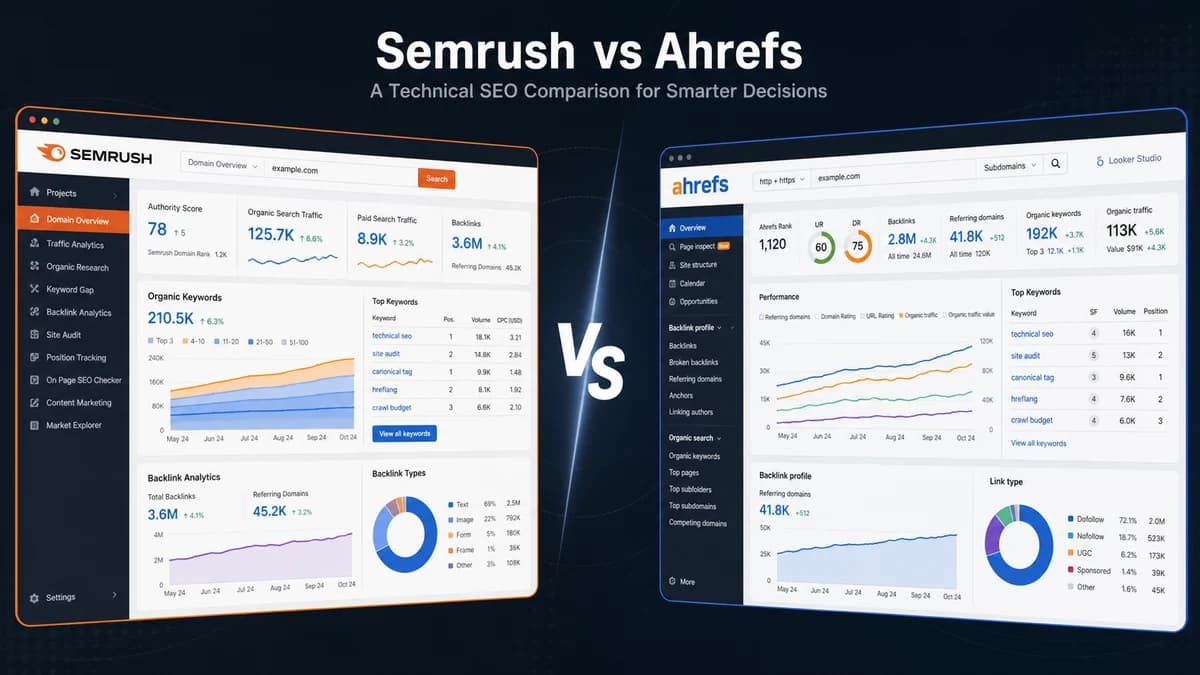
Ahrefs describes Domain Rating as its proprietary measure of backlink-profile strength on a logarithmic 0 to 100 scale. Its URL Rating is page level. Semrush describes Authority Score as a compound metric built from link power, estimated organic traffic, and spam indicators. These definitions are useful. They also confirm that the numbers belong to the vendors' own indexes and formulas.
Use a vendor metric to compare candidates inside the same tool, spot outliers, or prioritize manual review. Do not treat DR 40 as a pass mark, combine DR and Authority Score as if they were the same unit, or tell a client that Google raised a score Google does not publish.
A network view can reveal repeated relationships, clusters of related sites, or a profile dominated by one part of the web. It is a lead for investigation. A neat graph does not prove trust, and a messy graph does not prove manipulation.
Why Google, Ahrefs, and Semrush show different links
Each system crawls and stores the web differently. Google's Search Console Links report includes links Google has found over time, including links that may since have disappeared. The report does not tell you whether a link is nofollow. Google also groups linking sites by root domain and does not present the report as a complete live backlink database.
Ahrefs and Semrush operate their own crawlers and indexes. Their discovery times, grouping rules, historical coverage, treatment of redirects, and available filters differ. Two tools can therefore show different totals without either total being a universal truth.
For an audit, take the union of useful discoveries and verify the important rows on the live source page. Check that the link exists, is crawlable, has the reported attribute, reaches the intended destination, and still makes sense in context. That manual verification is where a backlink export becomes evidence.
What link spam looks like
Google's current spam policies list buying or selling links for ranking purposes, excessive link exchanges, automated link creation, low-quality directory links, distributed widget links, widely distributed footer or template links, optimized forum signatures, and low-value content created mainly to manipulate linking signals.
Intent and implementation matter. A paid community sponsorship can be legitimate advertising when the link is qualified with sponsored or nofollow. A reciprocal link between two businesses can help customers when the relationship is real. A directory can be useful when it is curated, relevant, maintained, and accurate. The risk appears when the main purpose is manufacturing ranking signals at scale.
Unknown spam links are not an automatic emergency. The Search Console help page says Google typically ignores known spam links. Investigate patterns you or a previous provider created, manual-action notices, sudden anchor-text manipulation, and large groups of artificial placements before assuming every strange domain requires removal.
Most small businesses should not start with disavow
Google calls the disavow tool an advanced feature that can harm search performance when used incorrectly. Its guidance says most sites do not need it. Google recommends disavowing only when a site has a considerable number of spammy, artificial, or low-quality links and those links have caused, or are likely to cause, a manual action.
A vendor's toxicity label is not enough by itself. Review how the link was obtained, the source page, the anchor pattern, the scale, and Search Console manual actions. Try removal first when your business or its SEO provider created the placements. Keep a record of decisions. Do not upload a large domain list because a dashboard turned red.
Where a Canadian small business can earn useful links
The best opportunities usually come from work the business already does, proof it already owns, or relationships it can build honestly.
| Source | Reason the link can exist | Good destination | Common mistake |
|---|---|---|---|
| Supplier or technology partner | Authorized dealer, implementation partner, integration, case study, or customer story. | Relevant service page, partner page, or documented case study. | Asking unrelated partners for keyword-rich links to the homepage. |
| Industry association or chamber | Membership, certification, committee work, event participation, or a useful member resource. | About page, location page, team profile, or the resource being referenced. | Joining only for a link and leaving the profile incomplete. |
| Local press and trade publications | Original data, a credible expert comment, a local change, or a documented business story. | Research page, report, biography, or source page with supporting detail. | Sending a generic company announcement with no reader value. |
| Community organization or event | Sponsorship, volunteering, venue support, training, or a public partnership. | Local service page, community page, or event-specific resource. | Expecting an unqualified ranking link as part of a paid sponsorship. |
| Curated Canadian directory | Accurate business discovery, professional verification, or local category browsing. | Homepage or matching location page with consistent business facts. | Submitting to hundreds of unmaintained directories because they accept every site. |
| Existing unlinked mention | The publisher already named the company, product, person, or research. | The page that helps the reader verify the mention. | Demanding a link where one would not improve the article. |
A .ca source can strengthen the Canadian context when its readers, subject, and location fit the business. The domain ending alone is not a quality certificate. The same rule applies to government, education, and news domains: inspect the actual page and the reason for the reference.
Build something another site can cite
Service pages rarely attract references just because they exist. A roofer's service page may convert well, but a journalist or association needs a reason to cite it. The site often needs a separate asset: original local data, a calculator, a clear checklist, a photographed field study, a comparison with stated methodology, a public template, or a case study with numbers the client approved.
The asset gives another publisher a reason to reference the site. Its internal links can then lead interested readers to the relevant service page; neither the asset nor that route guarantees a link or ranking change. This gives content and commercial pages different jobs. The resource answers a question other publishers need. The service page helps the right visitor take action.
For more acquisition tactics, use our white-hat link-building guide for Canadian SMBs. This article supplies the evaluation layer: which opportunities deserve time, which links need verification, and which reports should not drive decisions by themselves.
Turn the export into a destination and relationship decision
Tools are good at collecting rows. MAXUOD connects those rows to the offer, target market, service area, content inventory, current partnerships, lead quality, and implementation capacity. The objective is not to make the backlink report look large. It is to decide what should change.
| Audit signal | Business question | Next action |
|---|---|---|
| Most external links point to the homepage. | Does the site have any useful research, tools, local guides, or case evidence worth citing? | Build or improve one linkable asset and connect it to a priority service page. |
| A relevant local link was lost. | Did the source page change, did the target move, or did the relationship end? | Restore the destination, add the right redirect, or contact the partner with a specific correction. |
| Links send visits but few enquiries. | Does the destination match what the referring page promised? | Improve message match, proof, mobile usability, and the contact path before seeking more of the same traffic. |
| A competitor earns links to a data page. | Can the business produce credible evidence for its own market instead of copying the topic? | Plan original data, methodology, visuals, distribution, and an owner for outreach. |
Some businesses can manage this internally. If someone can verify links, maintain partnerships, publish useful assets, send careful outreach, and measure referral leads, self-service is sensible. A focused MAXUOD project is useful when the business has data but no priority, content but no distribution plan, or opportunities but no implementation owner.
Once the source and destination pass review, use the outreach guide to choose a specific relationship and make a useful pitch. This article stops at link evaluation; acquiring the link is a separate task.
Measure the work without claiming false causality
Track new relevant referring domains, verified live links, target-page distribution, qualified referral visits, assisted conversions, lost-link recovery, branded mentions, and Search Console movement on the pages receiving support. Also track the outreach pipeline: researched, contacted, replied, accepted, published, and verified.
Rankings can move because of content changes, technical fixes, competitors, intent shifts, location, seasonality, and search-system updates. Do not credit one backlink for every positive chart. Look for a pattern across several pieces of evidence and a time window that matches the work.
Editorial note: This guide shares MAXUOD Digital's professional view for educational purposes. It does not guarantee rankings, traffic, AI citations, or link acquisition. Search-engine policies and reporting tools can change. Verify current Google and Bing guidance before running a link campaign or using the disavow tool.
Buyer questions
Do backlinks still matter for SEO in 2026?
Yes. Google says links help it discover pages and act as relevance signals, and its link analysis systems remain part of the core ranking systems. Links are one set of signals among many and do not guarantee indexing or rankings.
What is the difference between a backlink and a referring domain?
A backlink is one detected link from an external page. A referring domain is the website that hosts one or more of those links. One domain can create many backlinks, so both counts need context.
How many backlinks does a small business need?
There is no universal number. The useful benchmark is the relevant pages and domains that support competitors in the same market, followed by the business value and risk of opportunities you can earn honestly.
Are nofollow backlinks useless?
No. A nofollow link may still send qualified visitors, document a relationship, support public business consistency, or introduce the brand to a relevant audience. Its search treatment is different from a regular editorial link, so report it accurately.
Should a small business buy backlinks?
Do not buy links to manipulate rankings. Paid advertising and sponsorships can be legitimate, but Google says compensated links should be qualified with sponsored or nofollow attributes. The placement should still have a clear audience and business purpose.
When should I disavow backlinks?
Google says most sites do not need the disavow tool. Consider it only when there is a considerable volume of artificial or low-quality links and those links have caused, or are likely to cause, a manual action. Review the evidence carefully because an incorrect file can harm performance.
Are business directory links useful?
A curated and maintained directory can help people discover the business and can support accurate local facts. Large unreviewed directory networks created mainly for links are different. Judge the audience, relevance, accuracy, editorial standards, and placement.
Related reading and sources
Read next on MAXUOD
External references
Need your backlink data turned into a work plan?
Send your website and one business goal. MAXUOD will review the pages, link sources, destinations, local relationships, and measurement gaps, then scope the smallest useful path from evidence to content, outreach, repair, or conversion work.