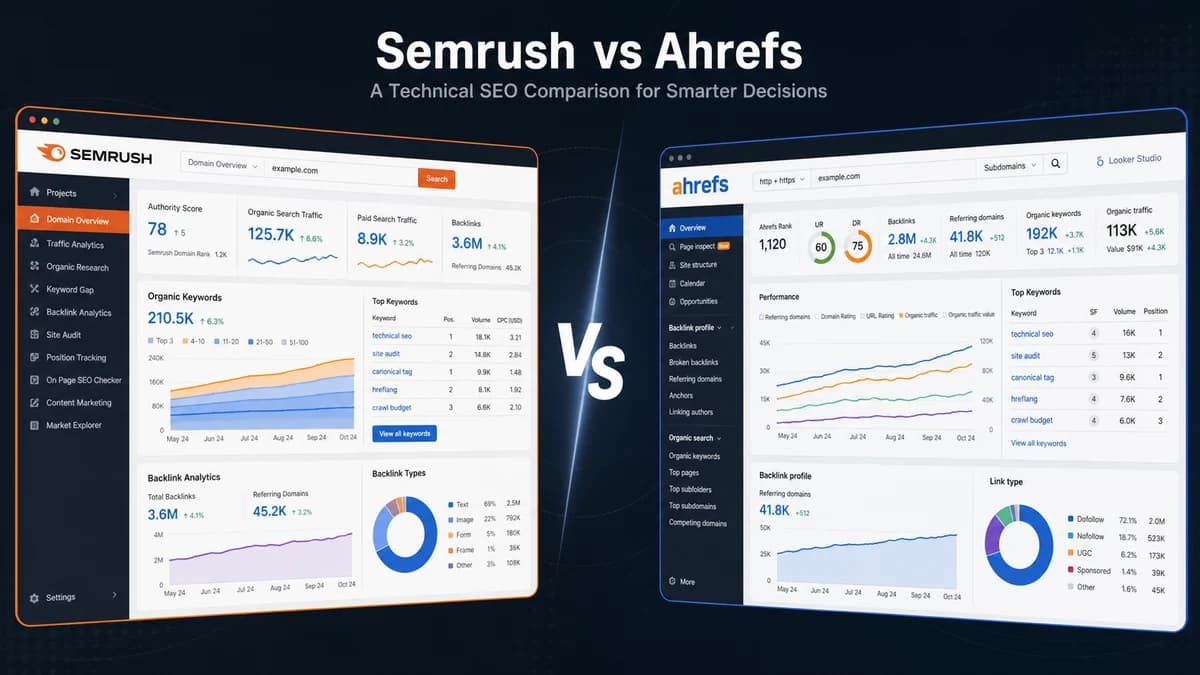
Semrush and Ahrefs are both serious SEO tools, but they push teams toward different habits. On its current product pages, Semrush presents a broad marketing workflow: keyword research, rank tracking, technical audits, content planning, local SEO, PPC research, reporting, and newer AI search visibility workflows. Ahrefs places its research tools around competitors, links, top pages, keywords, technical issues, and now brand visibility across search and AI surfaces.
That difference matters for small businesses. A Halifax clinic, contractor, restaurant group, software company, or professional service firm usually does not need every report in either platform. The useful question is narrower: which tool helps you decide what to fix, what to write, which competitors to watch, and where your brand is being discovered?
The original comparison was researched July 10, 2026; the product and pricing pages were reviewed again October 11. Both platforms now cover more than classic keyword and backlink work. The descriptions below come from those public sources and our workflow judgement, not a controlled head-to-head trial or an independent accuracy benchmark.
At MAXUOD Digital, we use professional tools as research inputs. The client does not need another export. They need someone to connect search data with the business model, service area, sales priorities, website limits, and available time, then carry the useful findings through to implementation and measurement.
The short version
If you need one broad operating platform for SEO work, reporting, local visibility, content planning, competitor research, and AI search monitoring, Semrush is often the easier first pick. If your work depends on competitor research, backlink analysis, top-page analysis, keyword research, technical audits, and clean SEO investigation, Ahrefs is often the better daily research tool.
| Decision area | Semrush tends to fit | Ahrefs tends to fit |
|---|---|---|
| Small business starting SEO | When the team wants one dashboard for SEO, AI search, content, local, reporting, and paid research. | When the team wants sharper research into pages, links, keywords, competitors, and technical issues. |
| Local SEO | Good fit when Google Business Profile, local listings, reviews, and reporting sit near the SEO workflow. | Useful for organic research and site health; the current plan page also lists a Google Business Profile monitor in beta. Check its limits against the specific local job rather than assuming either suite covers every listing task. |
| Backlinks | Strong enough for many SMBs, especially when paired with outreach workflow and gap analysis. | A sensible shortlist for a link-led workflow; compare useful results for the same domains before selecting it. |
| Content planning | Good when briefs, topic clusters, keyword gaps, and reporting need to live close together. | Good when the team wants to learn from top pages, traffic potential, parent topics, and competitors. |
| AI search/GEO | Semrush One and AI Visibility Toolkit make prompt tracking part of the paid plan structure. | Brand Radar and custom prompts make AI visibility part of the core research stack. |
| Agency/client reporting | Often easier when scheduled reports, Google Search Console, Google Analytics, and multi-client workflows matter. | Includes reporting functions and plan-dependent limits; compare the actual owner-facing report, scheduling, seats and source definitions. |
What Semrush is built to do
Semrush describes itself as a brand visibility management platform across SEO, AI search, content marketing, and paid media. Its own knowledge base lists keyword research and rank tracking, AI search visibility, competitive intelligence, site audit, backlink analytics and link building, content optimization, local SEO management, PPC research, reporting, and analytics.
That explains the product feel. Semrush is useful when a marketer has to move between keyword ideas, competitor gaps, on-page fixes, reporting, local profile work, PPC research, and management conversations in the same week. It is not only for technical SEO. It is built for a marketing operator who needs to turn data into a plan.
The SEO Toolkit page says the toolkit contains more than 20 tools and reports. The same page points to Site Audit, Position Tracking, Keyword Magic Tool, Organic Research, Keyword Gap, Backlink Gap, and reporting workflows. On the SEO product page, Semrush also describes tracking on Google, Bing, Baidu, ChatGPT, and AI Mode, plus AI search site health checks.
For an SMB, the upside is coverage. The risk is menu overload. A small business can buy a powerful tool and still fail if nobody owns the weekly workflow.
What Ahrefs is built to do
Ahrefs has long been associated with backlinks and competitive SEO research, and that DNA still shows. Site Explorer is framed around any website's traffic sources, top pages, discovery across search and AI, backlinks, and paid traffic. Keywords Explorer focuses on search queries, keyword ideas, clusters, search volume, traffic potential, and parent topics. Site Audit scans for more than 170 technical and on-page SEO issues, including Core Web Vitals, titles, meta descriptions, H1 tags, duplicates, indexability, localization, links, redirects, images, JavaScript, CSS, robots, sitemaps, and structured data.
Ahrefs has also moved into AI search and brand monitoring. The pricing page includes Brand Radar and custom prompts in its included tool list, and Site Explorer discusses organic and AI search performance. Its home and product pages now speak directly to AEO and brand visibility in AI answers.
The product feel is different from Semrush. Ahrefs is very good when you want to know why another site is winning. Which pages get traffic? Which links matter? Which sections are growing? Which topics have traffic potential? Which technical problems are blocking crawlers? That makes it strong for diagnosis and research-led content strategy.
Keyword research: do not stop at search volume
Both platforms do keyword research well enough for most SMBs. The important difference is how you use the data.
Semrush is useful when keyword research needs to become a content queue, competitor gap, position tracking set, brief, or reporting story. It can help a business move from "what do people search" to "which pages should we update, which clusters should we build, and how do we show progress next month?" The platform also connects keyword work to AI visibility and content planning, which matters if your team wants one place to manage the workflow.
Ahrefs is useful when you want to understand the keyword from the SERP outward. Its Keywords Explorer highlights metrics such as keyword difficulty, search volume, traffic potential, and parent topic. Traffic potential is especially useful because one page can rank for many queries. For SMB content planning, that can prevent the common mistake of building ten thin pages when one stronger page would cover the topic better.
The trap is treating third-party volume as exact truth. Neither platform is your own search demand. Use Search Console for actual impressions and clicks. Use Semrush or Ahrefs to understand the market around those queries.
Competitor research: the question decides the tool
Competitor research is where both tools earn their subscription, but the output can be very different.
| Question | Better workflow | Why it matters |
|---|---|---|
| Which competitors own the most search demand across SEO and paid? | Semrush | Its broader marketing view can connect organic, paid, keyword gaps, traffic estimates, and reporting. |
| Which competitor pages show estimated traffic and recorded links? | Ahrefs | Site Explorer is strong for top pages, backlinks, referring domains, site structure, and growth checks. |
| What should we write next? | Both | Semrush is good for clusters and gaps. Ahrefs is good for top-page and parent-topic research. |
| Which links are helping competitors? | Ahrefs | Backlink research is one of Ahrefs' clearest strengths. |
| How do we explain progress to a client or owner? | Semrush | Reporting, project dashboards, and integrations can make the story easier to package. |
For a local business, competitor research should not become a spreadsheet museum. Pick three to five competitors, compare the pages that win, note what their pages answer, then decide whether your page needs better local proof, stronger service detail, fresher photos, clearer FAQs, stronger internal links, or a better offer.
Choose the work before forwarding the export
A platform can show a ranking drop, a keyword gap, 200 crawl warnings, or a competitor with more referring domains. Those findings still need business context. A service page that brings qualified enquiries deserves attention before a low-value blog post, even when the blog post has more technical warnings.
This is where MAXUOD's work starts. We compare the tool output with your actual offer, margins, service area, customer questions, lead quality, sales notes, and capacity. Then we build a connected work chain: identify the signal, explain the business effect, choose the smallest useful fix, implement it, verify the page, and measure what changed.
| Tool finding | Business question | MAXUOD action chain |
|---|---|---|
| A service page has impressions but few clicks. | Is the query commercially useful, and does the search result match the offer? | Rewrite the title and description, improve the page promise, verify indexing, then compare clicks and enquiries. |
| The audit reports many technical issues. | Which problems block crawling, weaken a money page, or repeat across the site? | Fix blockers and shared templates first, re-run the crawl, then leave low-impact notices in the backlog. |
| A competitor has stronger backlinks. | Are those links relevant, reproducible, and tied to the page that competes with you? | Build a small outreach or local citation plan around sources that can improve trust with buyers. |
| Your brand is missing from AI answers. | Is the product or service explained consistently on your site and across public sources? | Correct entity facts, strengthen buyer answers and proof, distribute the same accurate claims, then repeat the prompt sample. |
Technical SEO audits: both are useful, but ownership matters
Technical audit tools can find hundreds of issues. The hard part is deciding which ones matter. Ahrefs says Site Audit identifies, prioritizes, and helps fix more than 170 SEO issues. Semrush's SEO Toolkit includes technical audit tools and an SEO dashboard that brings audit, rankings, and other project data into one view.
For most small websites, either tool can catch the basics: broken links, missing titles, duplicate content, indexability issues, redirect problems, slow pages, image issues, structured data problems, and crawl problems. The tool is less important than the fix queue.
A practical audit queue should sort issues into four buckets:
- Indexing blockers: pages that should be found but are noindexed, blocked, redirected poorly, canonicalized incorrectly, or missing from internal links.
- Conversion blockers: pages that rank or get traffic but have weak copy, unclear CTAs, thin proof, slow load, or a broken form.
- Template problems: repeated title, heading, schema, image, or internal-link issues that affect many pages at once.
- Nice-to-fix items: small warnings that do not change crawlability, user experience, conversion, or important rankings.
This is where Semrush can help teams package the work for managers, while Ahrefs can help SEOs inspect the problem in detail. Either way, do not send a raw audit export to a business owner and call it strategy.
Backlinks: compare the links you can actually use
Semrush has backlink analytics, backlink gap analysis, backlink audit, and link building workflows. That is enough for many SMBs, especially when link work is one part of a broader SEO plan.
Ahrefs' Site Explorer groups backlink records, referring domains, top pages and historical views around a site. That supports a link-led research workflow. A large vendor index does not establish that it finds the most useful links for your business, and headline index sizes are not comparable without their definitions.
Use Ahrefs first if your content plan depends on reverse-engineering linkable assets, comparing referring domains, finding broken backlink opportunities, or understanding why a competitor page has authority you cannot match. Use Semrush if your backlink work is tied to a broader weekly workflow that also includes content, rankings, local SEO, PPC, reporting, and AI search visibility.
AI search and GEO: buy the workflow, not the label
Both platforms offer AI-search research, but an SEO subscription, an AI discovery database and custom prompt tracking are different purchases. Semrush documents separate broad prompt, brand-performance and custom-tracking workflows. Ahrefs lists included tracked prompts as well as standalone Brand Radar and additional prompt-check packages. Confirm the exact assistants, locations, frequency, history and overage terms for the report you need; a product name in the plan table does not mean every dataset is included.
That sounds like a new category, but the operating work is familiar. You still need clean product facts, strong comparison pages, cited proof, fresh service pages, consistent local business information, review signals, and pages that answer buyer questions clearly. The new layer is measurement: which prompts mention you, which competitors appear, which URLs get cited, and whether the answer describes you accurately.
For a small business, a paid AI visibility dashboard should answer four questions:
- Does the brand appear for buyer prompts that match the service area and offer?
- Which pages, if any, are cited or used as evidence?
- Which competitors are named more often, and why?
- What content or entity facts need to be fixed next?
If the tool cannot change next week's work, it is a curiosity, not an SEO system.
Compare the bill for the work you need
Use the live Semrush and Ahrefs plan pages for your billing location and chosen period. Keep the currency and contract terms with the quote. This comparison does not carry forward its July price table as a current buying recommendation.
Build one buying record with the currency, monthly payment or annual commitment, included seats, sites, keyword limits, crawl allowance, AI prompt checks, reporting needs and optional add-ons. Distinguish an annual commitment displayed as a monthly equivalent from a cancelable monthly bill. Include tax and currency-conversion assumptions separately.
For custom prompt tracking, price the combination of prompts, platforms, locations and refresh frequency—not just the number of questions. A small allowance can disappear quickly when every question runs in two markets on several assistants. Inspect overage and automatic-charge settings before enabling them.
Then compare that software-and-review budget with the actual quote for a focused implementation project. Subscriptions buy continued access to data; a scoped MAXUOD engagement buys agreed diagnosis, changes, acceptance checks and a measurement handoff. Neither is automatically cheaper. A team doing recurring research may need platform access; an owner with one defined website problem may need the work completed.
Which one should a small business choose?
Choose Semrush if your SEO work is tied to marketing operations. That means weekly reporting, Google Search Console and Google Analytics context, local profile work, content briefs, keyword gaps, ranking movement, PPC research, AI visibility, and owner-friendly dashboards. It is especially practical when one marketer or agency has to manage several types of visibility from one place.
Choose Ahrefs if your SEO work is tied to investigation. That means competitor pages, backlinks, technical audits, link gaps, content opportunities, keyword intent, traffic potential, and search data that helps you understand why pages win. It is especially practical when the person using the tool already knows SEO and wants fast research more than hand-holding.
Use both only when the second tool changes decisions enough to pay for itself. Some agencies and mature in-house teams can justify that. Most small businesses should not start there. They should start with one tool, one owner, one weekly review, and a short list of decisions the subscription must improve.
Run one bounded comparison
If you are choosing between the two, do not compare screenshots. Run the same work through both tools.
- Pick one domain, three competitors, twenty target keywords, five buyer prompts, and the top ten service or content pages.
- Run a technical audit in both tools. Count only the issues you would actually fix in the next month.
- Build a keyword list in both tools. Score which one gives better page ideas, not just more keywords.
- Compare competitor top pages. Note which tool explains the competitor's advantage more clearly.
- Check backlink gaps. Decide whether the data creates outreach ideas or only adds noise.
- Test AI search prompts. Record whether your brand appears, which competitors appear, and which URLs get cited.
- Build one report for a non-SEO decision maker. The better tool is the one that helps them approve the right work.
At the agreed review point, inspect which findings led to accepted work, how much review they required and what remains missing. Keep the tool that fills the real gap. Check renewal and cancellation terms before removing another subscription.
How MAXUOD turns the data into a complete action chain
For a Canadian SMB, I would not buy both on day one. I would start with Google Search Console, Google Business Profile data, analytics, CRM or form data, and a plain list of commercial priorities. Then I would choose one paid platform based on the first bottleneck.
If the bottleneck is unclear content planning, thin local pages, weak reporting, scattered marketing work, and a need to measure AI visibility, I would lean Semrush. If the bottleneck is competitor analysis, backlinks, technical diagnosis, content gaps, and understanding why certain pages win, I would lean Ahrefs.
When MAXUOD manages the work, we do not stop at the recommendation. We agree on the business target, collect owned and third-party data, explain what matters, rank the fixes, update the site or hand off exact requirements, check that the changes work, and build the next review around leads and search evidence. That creates one line from finding to business result instead of separate reports.
Both tools are good. Neither fixes the website by itself. The value comes from turning the data into a small number of page updates, technical fixes, local profile improvements, content refreshes, and cited proof that a buyer can trust.
Editorial note and disclaimer: This article shares MAXUOD Digital's professional view for educational purposes. It does not provide purchasing, financial, or investment advice. No affiliate links are used. Product names, screenshots, features, plan limits, and prices belong to their respective owners and may change. Check the official vendor pages and decide according to your own needs, budget, and terms.
Buyer questions
Should I buy a paid SEO tool before using Search Console?
No. Start with Google Search Console, analytics, Google Business Profile data, leads, and sales notes. Paid tools are most useful after you know which decisions your owned data cannot answer.
Related reading and sources
Read next on MAXUOD
External references
Want the findings turned into completed SEO work?
Send your website and one business goal. MAXUOD will review the owned data first, use professional research tools where they add evidence, explain the priorities, and scope the smallest useful path from audit to implementation and measurement.