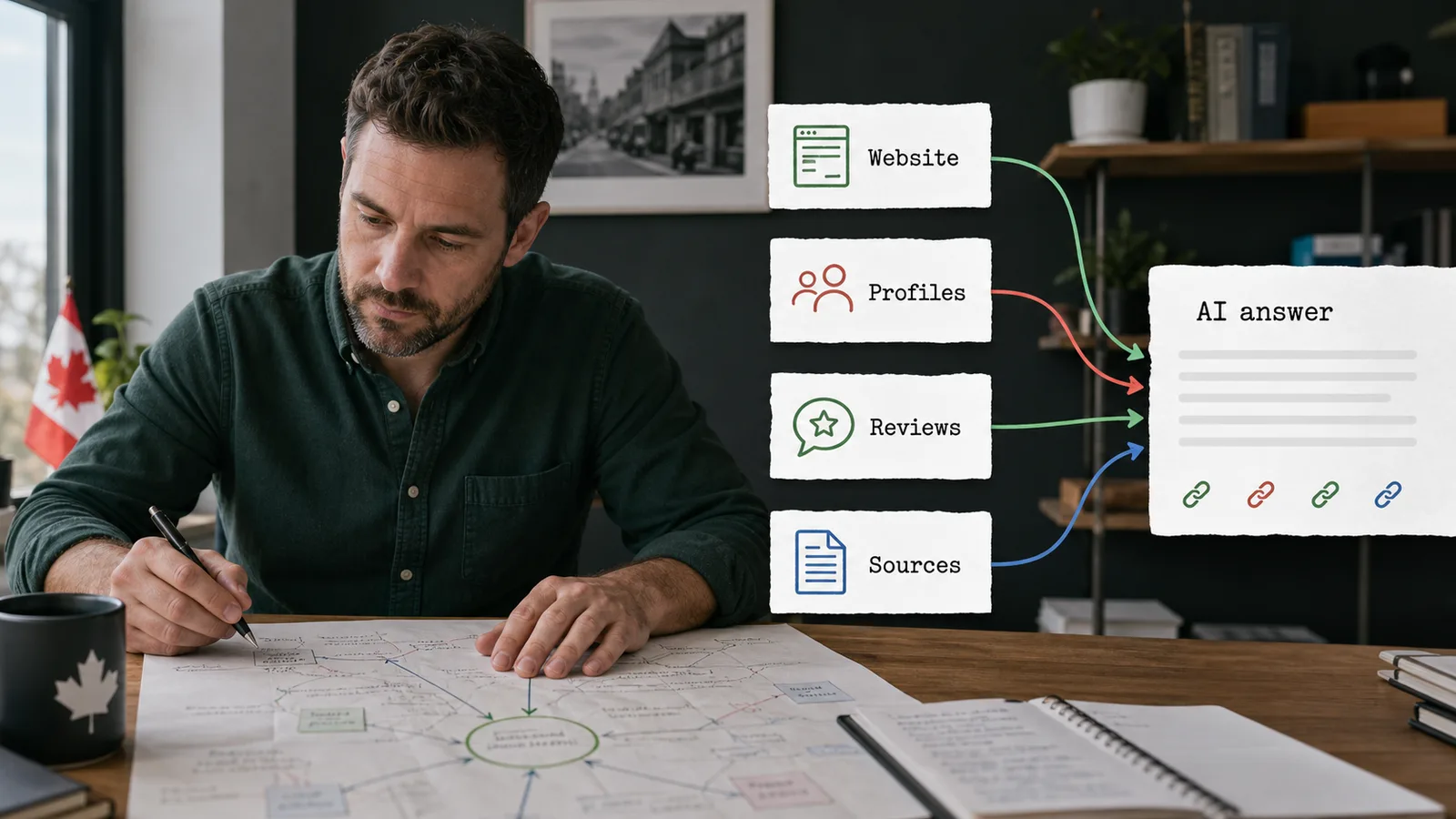
Imagine a Halifax service business with five public versions of itself. The homepage says it serves Halifax. Its Google Business Profile lists Halifax Regional Municipality. LinkedIn says it works across Canada. An old directory shows a phone number nobody monitors. The website's structured data still carries opening hours from before the last schedule change.
Each line may have been correct when somebody entered it. Together, they create a business that is difficult to verify. A customer may call the wrong number or assume the service is unavailable. A search engine has to reconcile conflicting fields. An AI answer can repeat whichever version it retrieves, whether or not that version is current.
Business information consistency means maintaining one approved set of facts, then publishing the applicable fields accurately across every surface. It does not mean copying the same promotional paragraph everywhere. The name, service area, hours, contact policy, website, services, and profile relationships should agree. The wording can still fit the channel.
That is why this work belongs to both SEO and GEO. Checked on July 10, 2026, Google's current Business Profile guidelines tell businesses to represent themselves consistently, keep the address or service area precise, choose only the categories needed to describe the core business, and avoid duplicate profiles. Google's AI features guidance also says structured data should match visible text and Business Profile information should remain current. There is no special AI file or schema that replaces those foundations. The broader GEO operating model shows where source consistency sits beside eligibility, page clarity, citations, and measurement.
Voice-and-camera search makes the same fact-control problem easier to encounter in a real-world task. The Google Search Live guide for Canadian local businesses explains how to test one spoken or visual customer question without treating the answer as a stable ranking.
One business can use different words without changing the facts
A homepage, a directory listing, and a LinkedIn About section have different jobs. The homepage needs to explain the offer and move a buyer toward contact. A local profile needs precise operational fields. LinkedIn may describe the company for partners, employees, and prospects. Their descriptions should not be identical.
The fixed facts underneath those descriptions should be controlled. A useful audit separates canonical fields from channel copy:
| Field | What should stay canonical | What may vary | Conflict that needs action |
|---|---|---|---|
| Business name | The public real-world name and approved spelling | Legal suffix where a form requires it | Keywords, city names, or taglines added to the profile name |
| Location model | Storefront, hybrid, or service-area status | How much local context the description explains | A hidden-address business publishing a residential or virtual-office address |
| Service area | The cities or regions the business can actually serve | Which location receives emphasis on a local landing page | A profile promises areas the service team or website does not support |
| Hours and contact | Current customer-facing hours, website, appointment path, and approved contact methods | CTA wording | Closed hours, abandoned phone numbers, or competing booking URLs |
| Services | The real offer, primary category, and scope boundaries | Length, examples, and buyer language | Profiles or schema claim services the business does not provide |
This distinction prevents two common mistakes. The first is treating every wording difference as an SEO emergency. The second is ignoring an operational conflict because two descriptions are not supposed to match word for word.
Build the packet before editing the profiles
Do not begin by opening six browser tabs and changing whichever field looks wrong. First create a canonical business packet. It can live in a controlled document or spreadsheet, but it needs an owner, a last-verified date, and a state for every field.
The packet should cover four groups:
- Identity: approved business name, legal name if different, canonical website, logo, short description, full description, and stable public profile URLs.
- Location and contact: storefront or service-area policy, public address visibility, city and province, service areas, phone policy, public email, hours, appointment URL, and holiday-hours process.
- Offer: primary category, secondary categories, service names, who each service is for, relevant licences or credentials, and claims the business can prove.
- Control: profile owner, manager access, verification status, current edit state, source of truth, last check, and next review date.
Use explicit states such as confirmed, pending platform review, decision conflict, not observed, and not applicable. A blank cell invites guessing. A pending field tells the team to wait.
For service-area businesses, the location policy is especially important. Google says a business that travels to customers and does not have a staffed storefront should use one service-area profile and hide its address from customers. Do not publish a home address, mailbox, or virtual office simply to make a citation look complete.
Fix conflicts in the order they can hurt the business
A 40-row audit is not a 40-item emergency. Rank conflicts by the damage they can cause and the confidence of the evidence. Eligibility and customer-contact problems come before missing photos or a slightly dated description.
Pending edits deserve their own rule. If Google is reviewing a change to business hours, do not immediately copy the intended hours into every directory and declare the profile synchronized. Record the old value, intended value, edit date, and review state. Once the business confirms the new customer-facing hours, publish that truth on the website and other controlled surfaces. Record Google's review as pending until it settles. Accurate operating hours should not be withheld elsewhere merely because one platform has not processed them yet.
If a Halifax business needs the conflicts reduced to one owned first step, the Halifax profile-to-page audit checks the local facts, website owner, and contact path before a broader sync.
Duplicate prevention matters for the same reason. Google's guidelines call for one profile per eligible business location. Before creating a new Google, Bing, Apple, Yelp, YellowPages.ca, 411.ca, or BBB record, search for an existing listing, confirm ownership, and decide whether it should be claimed, corrected, merged, or left alone.
The website must publish the same truth in visible text and code
The footer, contact page, About page, location pages, service pages, metadata, and structured data are all publication surfaces. If the visible page says one thing and JSON-LD says another, the markup is not a correction. It is another conflict.
Google's current AI-search guidance is unusually direct on this point: structured data should match the visible text, and there is no special schema required for AI Overviews or AI Mode. Its Organization structured data guide recommends using the properties that genuinely apply, including the business name, URL, logo, contact details, and stable public profiles through sameAs. The LocalBusiness guide recommends the most specific eligible business type and validation before release.
For a service-area company that does not publish a storefront address or phone, an identity record can stay accurate without inventing either field:
{
  "@context": "https://schema.org",
  "@type": "Organization",
  "@id": "YOUR_CANONICAL_URL#business",
  "name": "Harbour Example Services",
  "url": "YOUR_CANONICAL_URL",
  "logo": "YOUR_LOGO_URL",
  "email": "hello@example.ca",
  "sameAs": [
    "YOUR_LINKEDIN_COMPANY_URL"
  ]
}
The example is deliberately small. Add only stable, applicable facts. Publish service areas visibly on the relevant service or location page, then use appropriate Service or eligible local-business markup where it accurately represents that page. Do not add an address, phone, opening hours, reviews, or social URL merely because a validator allows the property.
Correct markup can help a system understand an entity. It does not guarantee a knowledge panel, local ranking, rich result, or AI citation.
Profiles should mirror facts, not the same paragraph
Once the packet is approved, work outward from the surfaces closest to the business:
- Website: resolve visible copy, conversion paths, and structured data first so the canonical URL publishes the approved facts.
- Google Business Profile: confirm the real-world name, eligibility, service-area or storefront status, category, services, hours, website, and contact fields. Wait for pending edits to settle.
- Bing and Apple: claim or update the existing record using the confirmed packet. Microsoft's Bing AI Performance announcement specifically points local businesses to Bing Places to keep address, hours, and contact information current.
- LinkedIn: align the company name, website, overview, service positioning, logo, and applicable location. LinkedIn's own Page guidance says accurate organization details help members make informed decisions.
- Canadian and industry sources: review relevant directories, associations, suppliers, review sites, and editorial mentions. Correct high-risk facts before adding new listings.
Apple's 2026 support guide notes that Apple Business now combines capabilities previously associated with Apple Business Connect and other Apple business products. The interface may change, but the operating requirement does not: assign ownership and keep the customer-facing location or brand record current.
Reviews and publications belong in the audit, but not in the packet
A review, Reddit discussion, association page, or industry article is not a field you control like website schema. It is independent public evidence. Track what it says, but do not try to make every third-party sentence match your approved description.
The useful question is narrower: does the source repeat a material fact that is now wrong? An old phone number in an association directory deserves a correction request. A review describing one customer's experience does not need to be rewritten to match marketing copy. A publication using an old brand name may need a polite update after a real rebrand.
Do not manufacture that consistency with scripted reviews, fake accounts, copied Reddit posts, or bulk directory submissions. The objective is the same accurate business behind independent sources, not identical language pretending to be independent.
MAXUOD adds the operating layer between the packet and the live profiles
A template is easy to download. The difficult work is deciding which version of a fact is current, which source is authoritative, which edit should happen first, who can approve it, and how the team will know the correction survived.
For this type of SEO and GEO engagement, MAXUOD turns the audit into five connected deliverables:
- Canonical packet: confirmed facts, unresolved decisions, source evidence, owners, and review dates.
- Conflict register: affected URLs and profiles, severity, customer or eligibility risk, and the required approval.
- Implementation queue: website copy, structured data, Google Business Profile, Bing, Apple, LinkedIn, and directory actions in dependency order.
- Verification log: submitted, pending, accepted, rejected, or recheck status with screenshots and dates.
- Measurement baseline: local visibility, profile actions, branded queries, cited pages, prompt samples, and qualified enquiries tied to the affected pages.
A single-location owner with one stable profile and straightforward website can maintain this packet without an agency. Help becomes more valuable when the business has several services or markets, hidden-address rules, duplicate profiles, pending edits, old directories, conflicting schema, or no internal owner who can carry a change across every surface.
A conflict needs an owner before it needs another tool
Assign responsibility by field, not platform. Otherwise the website developer fixes the schema while operations changes the hours and marketing publishes a third version on LinkedIn.
| Decision | Accountable owner | Implementation help | Completion evidence |
|---|---|---|---|
| Public name, rebrand, legal identity | Owner or leadership | Marketing, legal, profile managers | Approved name and dated rebrand record |
| Hours, service area, contact route | Operations | Local profile manager, website owner | Customer-facing value confirmed on live surfaces |
| Categories, services, positioning | Marketing plus service owner | SEO, content, sales | Profiles and service pages describe the same real offer |
| Website schema and technical release | Website owner | Developer or SEO implementer | Rendered HTML checked, schema validated, URL inspected |
| Reviews and third-party corrections | Marketing or customer team | Owner for sensitive responses | Correction requested or response published without manipulation |
Run the full audit after a rebrand, move, new location, changed phone, revised hours, material service change, website migration, acquisition, or ownership change. For a stable single-location business, a quarterly review plus event-triggered checks is a practical starting cadence.
Verify the correction on search and AI surfaces
Presence is not the same as correctness. After implementation, check the live website, rendered JSON-LD, profile member view, map result, directory record, and contact path. Test the phone, form, booking URL, and mobile CTA rather than assuming a saved field works.
Then measure the surfaces affected by the change:
- Google Business Profile actions, local landing-page clicks, branded and service-area queries, review velocity, and qualified calls or forms.
- Search Console landing pages and queries before and after a material site correction, with the change date annotated.
- Bing AI citations, cited pages, and grounding-query samples where AI Performance is available.
- A fixed monthly prompt sample that records the platform, date, location, business mention, cited URL, competing businesses, factual accuracy, and next action.
- A directory consistency status that distinguishes confirmed, pending, conflicting, duplicate, and not-applicable records.
Microsoft cautions that Bing AI Performance citation counts do not show ranking, importance, or placement in an individual answer. Use cited pages and grounding queries to find evidence, then inspect whether the underlying page and business facts are correct. A single prompt or citation is not proof that a consistency fix caused an AI result.
Completion has a clear definition
The work is complete when the business has one approved packet, no unresolved identity or lead-loss conflicts, no accidental duplicate profiles, visible website facts that agree with the markup, stable profile URLs, assigned owners, and a dated verification log.
The best final question is not "Are we listed everywhere?" It is: when one important business fact changes tomorrow, who updates the packet, which surfaces follow, and how will we know the old version is gone?
Editorial note: This article shares MAXUOD Digital's professional view for educational purposes. It does not guarantee rankings, local visibility, AI mentions, citations, or lead volume. Platform interfaces and policies can change; check the linked official guidance before changing a live profile. Google, Apple, Microsoft, Bing, LinkedIn, their interfaces, and their trademarks belong to their respective owners. No affiliate links are used.
Buyer questions
Is NAP consistency still important for local SEO?
Yes, but name, address, and phone are only part of the modern audit. Service-area status, hours, website and booking URLs, categories, services, profile ownership, structured data, and public descriptions can also create material conflicts.
Do all business descriptions need to be identical?
No. The wording should fit the platform and audience. Canonical facts such as the real business name, location model, service area, contact policy, website, hours, and actual services should remain consistent.
Should a service-area business publish its home address?
Not when customers are not served there. Google says eligible service-area businesses without a staffed storefront should hide the address and use an accurate service area instead.
Can structured data fix an inaccurate Google Business Profile?
No. Structured data should match visible website content, and each public profile still needs to be corrected in its own management system. Markup is not an override for stale or conflicting platform data.
How often should a business information audit run?
Run one after any rebrand, move, new location, hours or phone change, service change, site migration, acquisition, or ownership change. For a stable single-location business, a quarterly review plus event-triggered checks is a practical baseline.
Related reading and sources
Read next on MAXUOD
External references
Do your website and public profiles tell the same story?
MAXUOD can audit the canonical facts, service-area signals, structured data, profile conflicts, and measurement path, then reduce the findings to the first useful fixes.