Bing's AI Performance report can show citation context, not just a count. Microsoft's June 16, 2026 announcement introduced Intents, Topics, Citation Share and Compare in global preview. Use them to inspect the kinds of retrieval activity associated with your cited pages—not to prove why a particular answer selected them.
Citation Share is the percentage of citations attributed to your site out of all citations across sites for the same grounding query. Microsoft calls it an observational metric: it does not expose competitor domains, rank sites, grade content or measure traffic share. A changing percentage is a reason to inspect the underlying query and period, not proof that a page improved or deteriorated.
What changed
| New signal | What it helps answer | SMB use |
|---|---|---|
| Intents | What kind of need the grounding query appears to represent. | See whether citations come from research, comparison, local, commercial, or solve-style contexts. |
| Topics | Which broader themes your cited pages are associated with. | Check whether Bing understands your core services or is grouping you under weak/irrelevant themes. |
| Citation Share | Your share of citations for a grounding query. | Spot where you are strongly represented, barely present, or losing representation over time. |
| Compare | How citation activity changes between periods. | Review whether page updates, IndexNow submissions, or seasonal demand line up with movement. |
Grounding queries are not user keywords
This is the easiest mistake to make. A grounding query is a retrieval phrase the AI system used to support an answer. It is not necessarily what a user typed. Treat it as a window into how the system looked for evidence, not as a traditional keyword report.
That difference changes the workflow. If a grounding query says something like "Halifax SEO audit service page pricing factors," the task is not to stuff that phrase into a page. The task is to ask whether your pricing factors, audit scope, location, and service proof are clear enough for the system and the buyer.
A practical SMB workflow
- Export cited pages monthly. Keep the URL, citation count, grounding query, intent, topic, citation share, and date range.
- Group by page type. Separate homepage, service pages, blog guides, local pages, and contact/audit pages.
- Check the page's job. An informational article may be the right source for a research question. Inspect a related service page and its contact route only when the observed task is commercial or the reader needs a relevant next step.
- Review unexpected topic labels. Check the sampled grounding queries before editing. Microsoft says preview classifications can be broad for specialized domains; a label alone does not prove the page is unclear.
- Annotate changes. Record page edits, IndexNow submissions, profile updates, and new internal links before using Compare.
- Connect to leads. A citation without calls, forms, bookings, or audit requests is still only visibility.
How to turn signals into page work
Start with the retrieval task and the cited page. If the content is accurate and still useful, a change in share may need observation rather than editing. If a buyer question exposes a missing service boundary or an unsupported claim, improve that existing owner page. An unexpected topic label can come from broad preview classification, query mix or content ambiguity; inspect those possibilities before choosing a fix.
IndexNow is useful after meaningful changes because Bing and other participating engines can be notified about updated URLs. It does not guarantee crawling, indexing, ranking, or AI citations. Use it as part of a refresh workflow, not as a magic button.
What not to do
Do not call Citation Share an AI ranking score. Do not compare it directly with Google rankings or Search Console clicks. Do not chase every grounding query with a separate page. Do not assume Bing data tells you what happens in Google AI Overviews, AI Mode, ChatGPT, Claude, or Perplexity.
For SMBs, the value is focus. Bing's new signals help you see which pages AI systems already use, where your representation is thin, and which topics deserve clearer answers. That is enough to improve the next month of page work without pretending the report explains every AI answer engine.
Buyer questions
Are grounding queries the same as user searches?
No. Grounding queries are retrieval phrases used by the AI system to support answers. They should guide content review, not keyword stuffing.
Does Bing AI Performance cover Google AI Overviews?
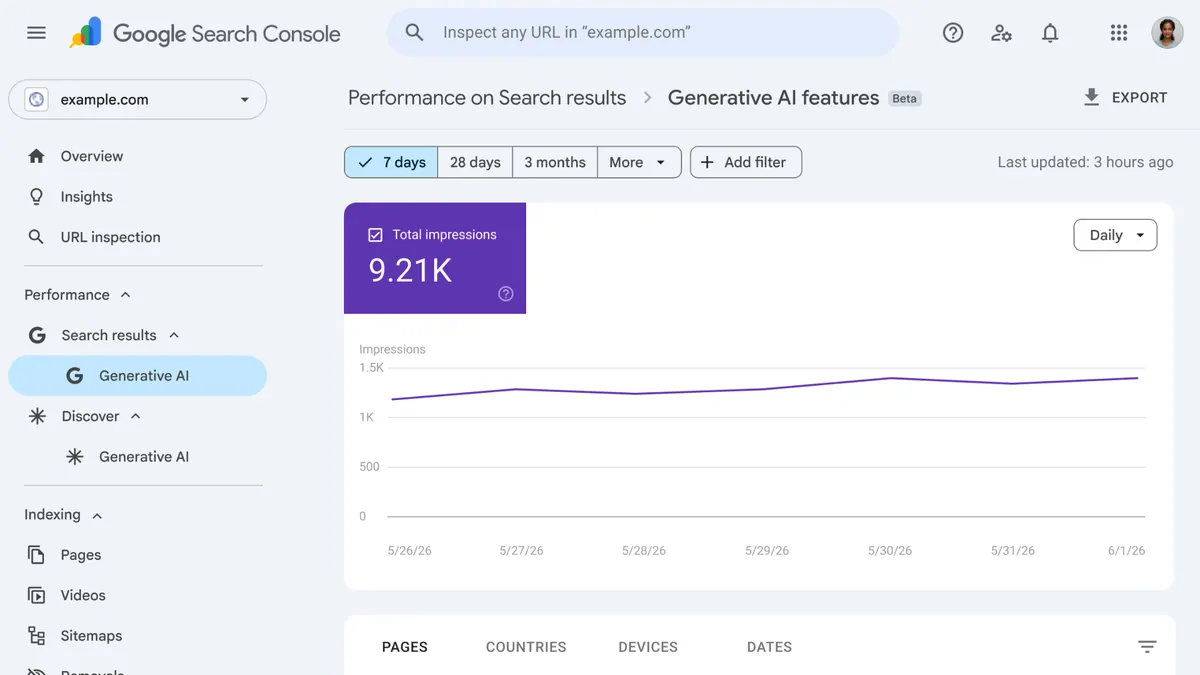
No. Use Bing AI Performance for Microsoft AI experiences, and use Search Console Generative AI reports where available for Google AI features.
Related reading and sources
Read next on MAXUOD
External references
Want AI citation data turned into page fixes?
MAXUOD can review Bing AI Performance, Search Console, prompt samples, service pages, and IndexNow workflow so the report becomes next actions instead of dashboard noise.