A useful small-business SEO report is a decision system, not a ranking export. It should show whether priority pages can be found and indexed, which queries and pages are gaining useful visibility, what local or AI-search surfaces are retrieving, which business actions followed, and what the team changed during the same period.
Those layers must stay separate. An indexed page has not necessarily earned impressions. An impression is not a visit. A visit is not a qualified enquiry. A citation in an AI answer is not a ranking. Combining them into one score hides the point where the customer journey is breaking.
What should a small-business SEO report measure?
| Reporting layer | Useful measures | Decision it supports |
|---|---|---|
| Discovery and indexing | Canonical URLs in the sitemap, indexed priority pages, exclusion reasons, crawl or server errors | Can Google access and retain the pages the business needs? |
| Search visibility | Page-level impressions, clicks, CTR, query families, country, device, and date comparisons | Which page owns demand, and where is the result or page misaligned? |
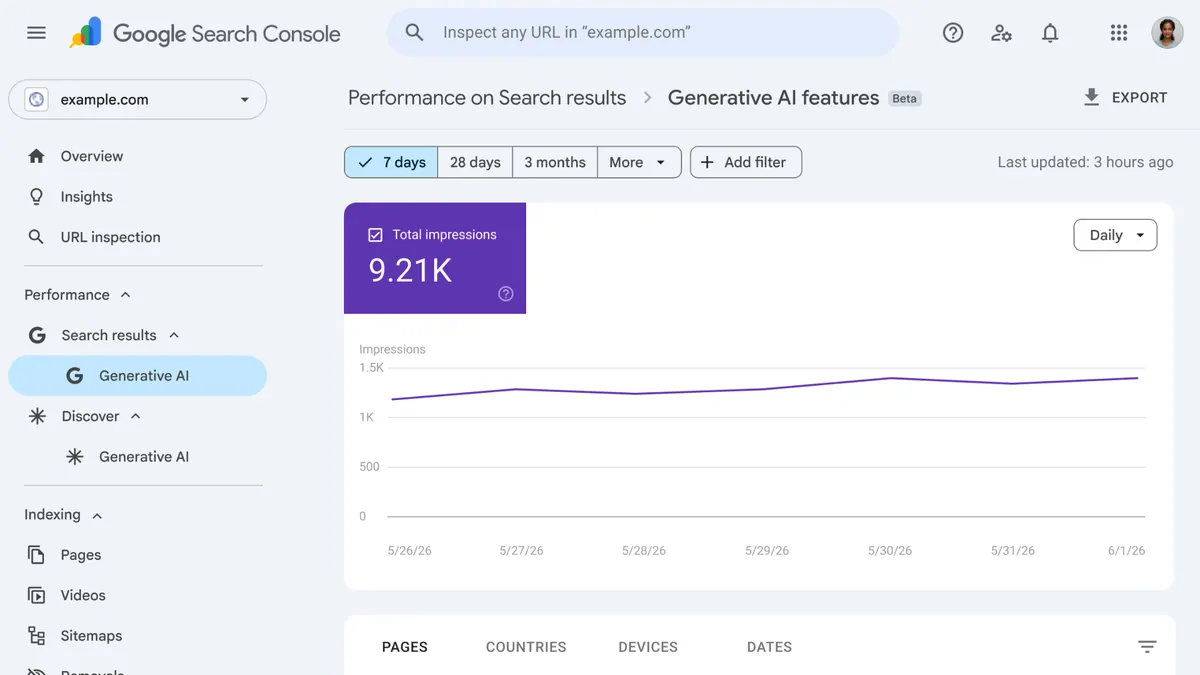
| Google AI-search exposure | Generative AI report link impressions, with page, country, device and date scope retained | Where are links to the site appearing in AI Overviews or AI Mode? |
| Social and video discovery | Clicks, impressions, queries, posts or videos, country, device, and format for each verified platform property | Which off-site content earns discovery in Google Search, and what should be repackaged or cross-promoted? |
| Local discovery | Business Profile searches, views, website clicks, calls, directions, messages, or bookings when available | Are nearby customers finding and acting on the profile? |
| AI-search retrieval | Bing citations and cited pages, grounding-query samples, fixed prompt observations, AI referrals | Which sources are being retrieved, and are business facts represented accurately? |
| Business outcomes | Received enquiries, qualification decisions, bookings and quotes; form events, email clicks and call taps tracked separately | Which recorded actions became suitable enquiries? |
| Delivery | Pages refreshed, links added, redirects fixed, profile facts corrected, tests passed, release date | What changed that could plausibly affect the later measures? |
The report does not need every row every month. A business without a public phone may omit call taps; one without a verified Business Profile cannot supply that profile's metrics. For Bing citations, first distinguish an accessible report showing zero in the selected window from a missing report or unavailable account. Only the first supports a zero baseline.
Index coverage comes before traffic interpretation
Start with the pages that are supposed to win enquiries: the homepage, priority services, relevant location or service-area pages, and the conversion page. Google says the Page indexing report shows the indexing state of URLs it knows about, but it does not expect every known URL to be indexed. Redirects, duplicate URLs, deliberate noindex pages, and genuine 404s can be valid exclusions.
A reporting table should therefore classify each reason before counting it as a problem:
- Expected exclusion: an old URL redirects to its replacement, or a duplicate resolves to the selected canonical.
- Website defect: a priority page returns a 404, carries an unintended
noindex, or points to the wrong canonical. - Needs page review: Google crawled the URL but did not index it, while the live page is technically available.
- Needs inspection: the aggregate report and the URL Inspection result disagree, or the tested rendering does not show the main content.
A sitemap submission is evidence that the site disclosed preferred URLs; it is not proof that Google indexed them. The report should name the affected URL, its intended role, the live status, Google-selected canonical when available, the action taken, and the next inspection date.
Read Search Console by page and query family
Google's Performance report provides clicks, impressions, CTR, and average position, with dimensions such as page, query, country, and device. Google recommends focusing more on trends in impressions and clicks than on position alone. Average position is the average topmost result for the property or page under the selected aggregation; it is not a stable universal rank.
Group close query variants into a useful intent family during analysis, but retain the raw rows. For example, company, agency, provider, specialist, and service variants may belong to one commercial page if the search intent and results overlap. A checklist, comparison, pricing-factor article, and service page may need separate owners because they answer different decisions.
Then ask four page-level questions:
- Is the intended page receiving impressions for the intended family?
- Are multiple pages appearing for the same family and weakening ownership?
- Does the title and opening answer the intent visible in the query data?
- Does the page provide a useful next step for that stage of the buyer journey?
Low CTR is not automatically a title problem. A page may have expanded into broader, lower-position queries, or a result feature may have changed the click opportunity. Compare the query mix, page, country, device, and dates before rewriting the snippet.
If Search Console clicks and Analytics visits tell different stories, use the GSC and GA4 mismatch diagnostic to check report scope, consent, production hostnames, and event receipt before turning that difference into an SEO recommendation.
Give social and video Search data its own property and owner
Google's July 29, 2026 guide documents how creators and marketing teams can analyze TikTok, Instagram, X, and YouTube content in Search Console. The platform-property feature itself was already being reported earlier in July; the new document adds an official working method. It says to add and verify each account separately, then use Insights and Performance reports to inspect the content, queries, countries, devices, dates, and Google surfaces sending discovery.
This data answers a question that a website property cannot: which off-site post, video, channel page, or profile is being found through Google? It can show a 28-day overview, a 24-hour view for recent content, query groups, and comparisons such as YouTube Shorts versus full-length videos or Instagram Reels versus posts. Teams can export comparable rows across platform properties, but the exports remain separate datasets with different content formats and audiences.
Do not add those clicks to website organic clicks and call the result "SEO growth." Keep the account, content URL, platform property, query or query group, country, device, Google surface, format, and observation window in the row. If the team changes a title, caption, hashtag set, or cross-promotion route, add a dated annotation and wait for a useful comparison window.
Availability needs a visible boundary. Platform properties and Search profiles are separate products. As checked on October 11, 2026, Search profile creation supports Canada, India and the United States, with age, policy and follower eligibility requirements; creating one does not directly improve Search ranking. An unavailable property or report should remain unavailable in the scorecard.
Keep local actions and AI citations in their own columns
Google's generative AI performance report, rolled out worldwide by August 31, 2026, reports link impressions from AI Overviews and AI Mode. These are part of Web Search data, not an extra total to add to it, and not a count of recommendations or visits. Preserve the report's date, page, country and device scope. If the report is missing, record unavailable; its exports turn unavailable values into zeros, so check the interface before treating an exported zero as observed absence.
Google Business Profile performance can include searches, views, website clicks, calls, directions, messages, and bookings, depending on the profile and business type. Google notes that not every metric applies to every business. These actions complement website reporting; they should not be silently added to organic website conversions as if they were measured in the same system.
Bing Webmaster Tools' AI Performance report measures another event: publisher URLs displayed as sources across supported Microsoft AI experiences. Total citations, cited pages, and grounding-query samples help identify retrieved topics and pages. Bing explicitly says those fields do not indicate ranking, authority, answer placement, or the role a page played in an individual answer.
For ChatGPT, Gemini, Perplexity, and other assistants, use a fixed prompt ledger when owned reporting is unavailable. Record the platform, date, location setting, exact prompt, brand mention, cited URL, competitor set, and description accuracy. A monthly repeated sample is more useful than a collection of favourable screenshots.
Connect visibility to enquiries without collecting unnecessary data
The business outcome layer can be simple. Record completed forms, email clicks, calls or bookings when those paths exist, then qualify the result in the CRM or lead ledger. Do not send names, email addresses, message text, or other form contents into analytics events.
A privacy-focused analytics product can cover page views, referrers, countries, devices, and landing pages without rebuilding an individual visitor's browsing history. Vercel states that its Web Analytics product uses aggregated, anonymous page-view data and does not use third-party cookies. Whatever platform you choose, document the fields collected and keep the privacy and cookie pages consistent with the implementation.
Every chart needs a change ledger
A performance graph without a release log encourages false attribution. Add one row for each material website, profile, social-account, or content change:
| Date | URL or surface | Change | Reason | Verification | Next review |
|---|---|---|---|---|---|
| Release date | Exact page, profile, account, post, or video | What was added, removed, or corrected | Query, crawl, buyer, discovery, or conversion evidence | Status, canonical, schema, links, mobile, event, account, or annotation check | Decision window |
The ledger does not prove causation. It establishes chronology and prevents the team from forgetting that a title, redirect, service description, tracking rule, or profile field changed during the comparison window.
Use different review rhythms for different jobs
- After a migration or major release: monitor availability, indexing, redirects, forms, and critical errors closely until the release is stable.
- During active SEO implementation: review the change ledger and priority pages weekly, but avoid rewriting titles or ownership every week.
- For a stable SMB site: a monthly decision report is usually enough, supported by alerts for outages or serious errors.
- Quarterly: revisit keyword ownership, content decay, local profile consistency, referring sources, and whether the measurement stack still answers the business questions.
The right cadence follows the rate of meaningful change. More dashboards do not create more evidence.
If you are choosing a provider, ask to see the handoff as well as the charts. Our illustrative weekly service update shows how completed work, unresolved evidence and the next approval can sit together without inventing a success story.
MAXUOD turns the report into an owned release queue
MAXUOD does not stop at exporting website Search Console, platform properties, Business Profile, Bing, or analytics data. We connect each signal to the business's services, geography, page or account owner, customer language, conversion path, and implementation capacity. The output is a short release queue with an owner, acceptance checks, and a review date.
That chain matters when the data conflicts. A high-impression query may belong to the existing service page, not a new article. A social post may deserve a website follow-up, another platform edit, or no change at all. A crawled-but-not-indexed URL may need consolidation, stronger internal discovery, or a clearer purpose rather than another indexing request. An AI citation may reveal an accurate source page but a weak contact path. The useful deliverable is the decision and verified change, not the number on its own.
A compact monthly report structure
- Decision summary: what changed, what the evidence supports, and the one priority for the next period.
- Discovery and index health: priority URLs, valid exclusions, defects, and inspections.
- Page and query movement: impressions, clicks, CTR, query ownership, and material segment changes.
- Off-site, local, and AI visibility: applicable social or video property rows, profile actions, citations, cited pages, and prompt observations, kept as separate evidence.
- Business actions: qualified enquiries and the landing pages or profiles associated with them.
- Release ledger: implemented changes and verification evidence.
- Next queue: three to five owned actions, including what will not be changed yet.
A report has done its job when the owner can decide what to keep, improve, consolidate, create, verify, or stop. Everything else is supporting evidence.
Editorial note: This article provides educational reporting guidance, not a guarantee of rankings, traffic, citations, conversions, or revenue. Report availability and definitions can change by property, account and market. The July platform-property guidance and later October checks are dated above; the generative AI report definition was rechecked October 16, 2026. Verify the current interface and preserve unavailable fields rather than converting them into zero.
Buyer questions
How often should SEO reporting happen?
Monthly is usually suitable for a stable SMB site. Review more frequently during a migration, outage, launch, or active technical fix, then reduce the cadence once the release is stable.
Does a submitted sitemap mean every page should be indexed?
No. Google describes sitemap submission as a hint and does not expect every known URL to be indexed. Report on canonical priority pages and classify redirects, duplicates, noindex pages, and 404s before treating exclusions as defects.
Related reading and sources
Read next on MAXUOD
External references
Choose the next measurable SEO action
Use Free SEO Writer to plan one evidence-led content release, or request a human-reviewed audit when the problem spans the wider site.