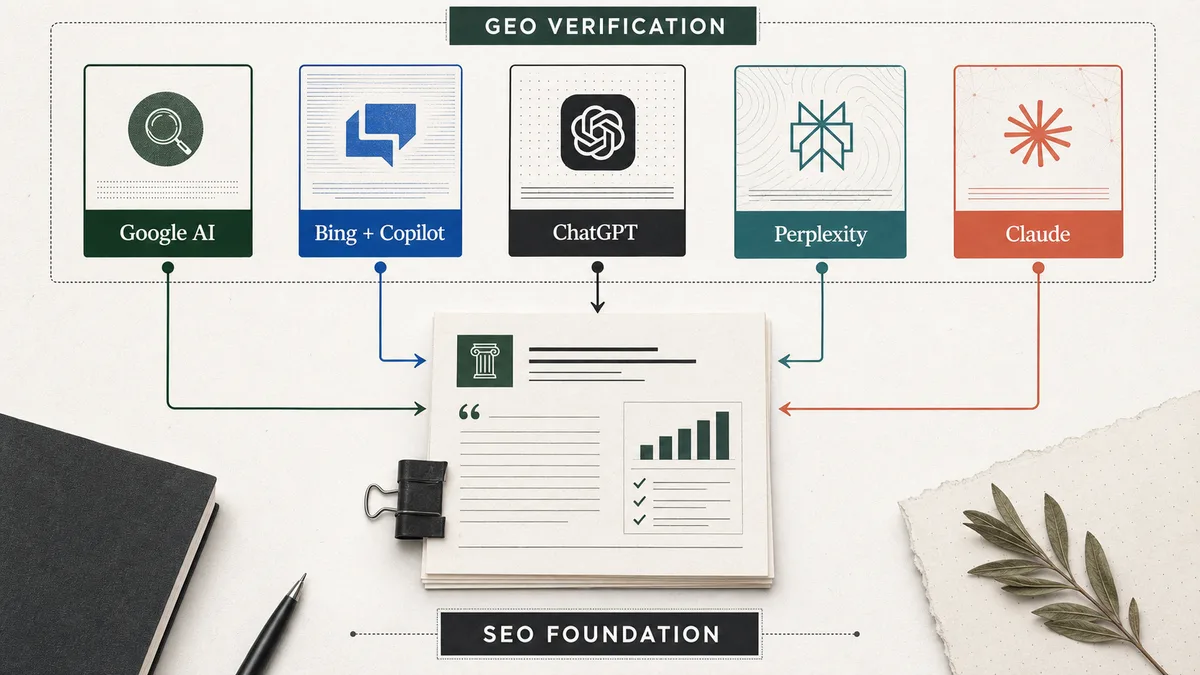
Choosing between Google SEO and Bing SEO is the wrong operating question for a North American business. The useful default is one strong website foundation, connected to two separately verified search ecosystems.
This does not mean splitting time or budget equally. It means refusing a permanent blind spot. Google Search, Maps, Search Console, AI Overviews, and AI Mode form one discovery and measurement environment. Bing Search, Bing Webmaster Tools, Bing Places, Microsoft Copilot, and Microsoft partner integrations form another. The same service page may be eligible in both, but its discovery, reporting, local facts, and AI citations are not controlled from one dashboard.
Our recommendation is to synchronize the foundations, then prioritize effort according to each business's owned query, page, and lead evidence. “Google first” can be a sequence. It should not quietly become “Bing never.”
The choice is wrong: shared website, separate control planes
Most of the work should be shared. A crawlable page, a clear service promise, useful evidence, descriptive internal links, a sensible canonical URL, accurate structured data, and a working contact path do not need separate Google and Bing versions. Publishing two near-duplicate articles for two engines would create a page-ownership problem, not a search strategy.
The platform controls are separate. Each ecosystem has its own property verification, crawl and indexing reports, performance definitions, local-business surface, submission workflow, and AI-search visibility. That separation changes the operating record a business needs.
| Work | Shared website asset | Google record | Bing / Microsoft record |
|---|---|---|---|
| Discovery | Crawlable links, canonical sitemap, stable URLs | Search Console indexing and URL inspection | Bing Webmaster Tools crawl/index reports and IndexNow receipt |
| Search performance | One page owner for each query family | Queries, pages, countries, devices, impressions, and clicks in Search Console | Search Performance data in Bing Webmaster Tools |
| Local visibility | Approved business name, service area, hours, services, and website | Google Business Profile | Bing Places for Business |
| AI visibility | Indexable, specific, sourced, current pages | Google AI features use existing Search eligibility and SEO fundamentals | AI Performance reports citations, cited pages, and sampled grounding queries across supported Microsoft experiences |
| Next release | One prioritized change with a page owner and verification date | Review the Google result and report | Review the Bing result, IndexNow receipt, and applicable AI citation record |
One website system feeds two control planes. The work overlaps heavily, but the evidence should not be merged until its definitions and limitations are understood.
Google supplies a core search, local, and AI eligibility record
Google Search Console's Performance report shows how a verified site performs in Google Search. Its dimensions include queries, pages, countries, devices, and dates, while its metrics include impressions and clicks. Google also documents limitations: anonymized queries are omitted, some data is truncated, and most page-level performance is attributed to the canonical URL. A Search Console export is evidence about Google; it is not a complete transcript of all search demand.
The sitemap is part of the discovery layer. Google's sitemap guidance explains that a sitemap identifies important URLs and relationships, but does not guarantee crawling or indexing. Crawlable internal links and a coherent page architecture still matter.
Google's AI-search guidance reinforces the same foundation. Google says that AI Overviews and AI Mode do not require a separate technical optimization. A supporting page must already be indexed, eligible for Google Search, and able to appear with a snippet. In other words, the Google AI layer does not rescue an unclear or ineligible page.
For an eligible local business, Google Business Profile manages information shown in Search and Maps. Website facts and profile facts should agree. If the site says Halifax and HRM while the profile uses a different service area, the answer is not more content. The answer is an approved fact record and a controlled correction.
Bing adds a separate search record and a visible Microsoft AI layer
Bing Webmaster Tools covers familiar SEO work: site verification, crawl and index health, sitemaps, URL submission, and search performance. It also exposes a platform-specific workflow Google does not mirror in the same way: Bing recommends IndexNow for notifying participating engines when a URL is added, updated, or deleted.
IndexNow is a notification, not an indexing guarantee. Bing's own guidance states that submission makes engines aware of a change but does not guarantee that a page will be crawled or indexed. Use it for real changes, monitor receipt, and keep the sitemap and internal links healthy.
The Microsoft AI connection makes Bing harder to dismiss as a second-place copy of Google. Microsoft documents that when Microsoft 365 Copilot Chat and agents use web search, Copilot generates a short query and sends it to Bing. The resulting web information can support the answer. That does not mean every Bing ranking becomes a Copilot citation, or that every Copilot interaction sends a website visit. It means Bing's web index participates in a wider Microsoft discovery environment.
Bing Webmaster Tools' AI Performance report makes part of that environment observable. Microsoft says the report covers supported experiences including Microsoft Copilot, AI-generated summaries in Bing, and select partner integrations. It can show total citations, average cited pages, page-level citation activity, and a sample of grounding queries. Microsoft also states that those fields do not prove ranking, authority, answer placement, or the role a page played in an individual response.
That boundary matters. A citation count is not a lead, and a grounding query sample is not market demand. It is still a useful signal that cannot be recovered from Google Search Console.
North America raises the cost of leaving one ecosystem unverified
We do not need a dramatic market-share statistic to justify a two-platform baseline. North American buyers can encounter a business through Google Search and Maps, while Microsoft users may encounter web-grounded information through Bing and Copilot inside a work environment. The surfaces, reports, and local profiles are different enough that absence from one cannot be diagnosed from the other.
This is particularly relevant to B2B services, professional firms, technology vendors, and businesses selling into organizations that use Microsoft 365. The point is not that every employee uses Copilot or that Bing and Google have equal reach. The evidence does not establish that. The point is that Microsoft officially uses Bing for Copilot web search, while Google operates its own Search, Maps, and AI-search system. A North American visibility plan should be able to inspect both.
Canada adds another practical reason for discipline: local and service-area facts can change by city, province, language, and delivery model. A business should not maintain one set of approved hours and coverage on Google, another on Bing, and a third on its website. Platform expansion increases the value of one canonical business-fact packet.
Build one content system, not two engine-specific versions
The shared foundation should do most of the work:
- Assign one primary intent to each important URL.
- Explain the service, audience, geography, scope, evidence, and next step in visible copy.
- Use descriptive internal links so important pages are discoverable without JavaScript-only navigation.
- Keep canonical tags, status codes, sitemaps, structured data, and mobile rendering consistent with the intended page.
- Update or consolidate an existing owner instead of publishing a close variant for another engine.
- Verify claims, sources, dates, local details, and contact paths before release.
This is also the boundary for AI-assisted writing. MAXUOD's Free SEO Writer can read a public website, rank topic opportunities, and prepare a business-grounded first draft. It should not create a Google version and a Bing version. The human decision is whether the topic deserves a page, which URL owns it, and what evidence makes the final version reliable across both systems.
Need one content opportunity, not two platform-specific drafts? Run the public website through Free SEO Writer, then review page ownership and release readiness before publishing.
Run the platforms as paired operating records
A small business does not need two SEO departments. It needs a short operating routine with named owners.
- Verify both properties. Use the correct canonical host and preserve account ownership that belongs to the business.
- Submit the same canonical sitemap. Do not maintain conflicting URL inventories for Google and Bing.
- Use the correct change signal. Inspect or request recrawling in Google's documented workflow when justified; send added, updated, or deleted URLs through IndexNow for participating engines.
- Align local facts. Compare the website, Google Business Profile, and Bing Places against one approved record before editing.
- Read reports separately. Record Google queries and pages, Bing search performance, Bing AI citations and grounding-query samples, local actions, and qualified enquiries without pretending the fields are equivalent.
- Ship one owned change. Improve the page, link, profile field, technical condition, or contact path supported by the evidence, then verify it in both ecosystems.
A useful monthly row can be compact: URL, intended query family, Google index status, Bing index status, Google impressions and clicks, Bing impressions and clicks, supported Microsoft AI citation fields, local-profile change, qualified enquiries, release date, and next review. Record unavailable data as unavailable, not zero.
Where businesses waste time
Equal effort is not the goal. If owned evidence shows Google currently supplies most qualified discovery, it may deserve more analysis and implementation time. The minimum Bing baseline can still be verified, automated, and reviewed without pretending the platforms have equal commercial value.
Submission is not optimization. Sending a URL through IndexNow or requesting a Google recrawl does not repair a weak page, a duplicate owner, a wrong canonical, or an unsupported claim. Discovery tools tell a platform that a page exists or changed; they do not create relevance or quality.
Two dashboards are not two strategies. The reports should converge on one release queue. If Google shows a commercial query reaching the wrong page and Bing shows a related cited page, the next action may still be one ownership fix and a stronger internal route.
More profiles are not automatically better. Claim or update the real business record. Do not create duplicate profiles, invent offices, publish an unapproved phone number, or broaden a service area only to occupy another surface.
One page map, two platform records, one release queue
MAXUOD's role is not to export two dashboards and call the work complete. We connect the platform evidence to the business's services, service area, customer questions, page owners, contact path, and implementation capacity.
A focused dual-platform audit can produce a canonical URL inventory, Google and Bing verification record, sitemap and indexing check, local business-fact matrix, IndexNow implementation or test, query-to-page map, AI citation baseline where available, and one prioritized release queue. The same packet states what is unknown and who owns the next action.
Self-service is reasonable when the team can maintain the accounts, interpret the reports, change the website, verify the release, and connect it to lead quality. A scoped engagement is more useful when those responsibilities are split across vendors or nobody owns the final handoff.
The practical default
Do not choose a permanent search winner. Maintain one useful, technically eligible website. Verify it in Google Search Console and Bing Webmaster Tools. Keep eligible local profiles accurate. Use each platform's discovery and reporting tools for the job they actually perform. Then prioritize implementation according to qualified business evidence.
Google may deserve more effort for a particular business. Bing may reveal a Microsoft search or AI opportunity Google cannot show. The ratio can change. The foundation should not have to be rebuilt when it does.
Editorial and platform disclosure: This article shares MAXUOD's professional view for educational purposes. Google, Bing, Microsoft Copilot, Search Console, Webmaster Tools, Business Profile, Places, and IndexNow features can change. Product names, interfaces, screenshots, and trademarks belong to their owners. Eligibility, submission, indexing, ranking, traffic, citations, and enquiries are not guaranteed.
Related reading and sources
Read next on MAXUOD
External references
Need one search foundation checked across both ecosystems?
Send the website for a free SEO and GEO audit. MAXUOD will identify the shared page or technical issue, the platform-specific records to verify, and the smallest useful next release.