For a small business in Canada or the US, the best starting point is usually Google Search Console, Bing Webmaster Tools and a short, repeatable list of buyer questions. Pay for AI visibility tracking when collecting the same evidence has become a recurring job—not because a dashboard gives your business a low score.
The important distinction is finding opportunities versus tracking the questions you chose. A discovery database can show competitors and sources you missed. Custom tracking follows an agreed question set over time. Neither, on its own, tells you which website change will bring a qualified enquiry.
Which AI visibility tool should a small business choose?
| Your job | Shortlist | What to inspect before choosing |
|---|---|---|
| Establish a baseline for one business and market | Owned search reports plus a dated prompt ledger | Keep exact questions, platform/mode, market, language, answers and source links. A small sample is not a stable rank or market-wide probability. |
| Make use of a tool you already pay for | Check your existing SEO subscription first | Confirm included AI reports and custom-check allowances. Access to one module does not mean every assistant, market or export is included. |
| Repeat your own buyer questions and compare competitors | Ahrefs Custom Prompts or Semrush Prompt Tracking | Inspect answer-level evidence, supported assistants and locations, check accounting, refresh schedule and exports. Do not confuse a tracked-prompt allowance with unlimited observations. |
| Discover competitor mentions and cited sources you have not considered | Ahrefs AI Visibility Index or Semrush discovery reports | Check the database's geography and answer dates. Broad discovery coverage may miss the local task you actually sell. |
| Turn findings into website changes | An in-house owner or a scoped analyst review | Agree who will interpret the answers, change the page and verify the result. MAXUOD can handle a scoped review using GEO Proof Lab; this is not a public self-service tracker or a guaranteed recommendation. |
For a local business, check the actual service area and language. A nationwide score may tell a Halifax office-cleaning company very little about buyers who need after-hours service in its area. Ask to inspect that kind of question before buying. A worldwide score is not a Canadian baseline, and an API response is not proof of what a signed-out customer saw in ChatGPT or Google AI Overviews. These are selection criteria, not results from a MAXUOD paid-platform test.
What does AI visibility tracking cost?
These vendor-published entry points were checked on October 16, 2026. Amounts are USD, not CAD. They describe different packages, so the cheapest headline is not automatically the cheapest way to do your job. Confirm checkout currency, taxes, renewal, overages and any base-plan requirement.
| Route | Published price / allowance | Important limit |
|---|---|---|
| GSC, Bing and a manual question ledger | No subscription fee for those platform reports | Someone still has to repeat the observations, review sources and do the work. |
| Ahrefs Custom Prompts Basic | $50/month for 2,500 checks | Checks are not unique prompts. Frequency, assistants and locations multiply usage; Basic overage is $0.020/check. |
| Ahrefs AI Visibility Index | $199/month for one platform index; $699/month for all, including 2,500 custom checks | A broad discovery dataset, not the same purchase as a custom-only prompt plan. Confirm purchase eligibility and any underlying plan requirement. |
| Semrush AI Visibility Base | $99/month per domain, billed annually; 25 daily tracked custom prompts | The price card specifies annual billing. Do not read that as a verified month-to-month checkout offer. Domain, location, teammate and extra-prompt charges need checking. |
Before adding a subscription, check your current allowance. Ahrefs' custom-prompt guide lists 150, 300 and 600 monthly checks for Lite, Standard and Advanced respectively. Its ordinary accounting is one prompt × assistant × location × update. The Brand Radar help page describes Claude as an exception: API-based collection using eight checks per update.
For a labelled planning example, 10 prompts × 3 ordinary assistants × 2 locations × 30 days of daily checking = 1,800 checks. That is an allowance calculation, not 1,800 customers or measured demand. Reducing frequency may be more sensible than buying more checks if you only make a decision monthly. Semrush's prompt allowance is packaged differently; do not compare the two numbers as equivalent units.
The Semrush knowledge base separates daily custom tracking from weekly Brand Performance reporting. It also documents CSV limits of 1,000 rows per export and 10 exports per user per day with an active subscription. Ask about the export you need, not just whether the platform has an Export button. Ahrefs' Brand-Radar-specific export quota was not established in this review.
Ask for one relevant answer before you subscribe
Use a question a customer could genuinely ask, with its actual market and service constraint. In the sample or export, look for the exact prompt, assistant and mode, location, observation date, response, cited URL and named competitors. Keep missing fields marked as missing. Canada or US support somewhere in a product does not prove the same coverage in every module, and a language selector does not prove reproducibility.
If you need client-ready reporting, add one more test: can another person open the cited source and understand why the proposed change follows? A score without the answer, source and implementation owner is a weak handoff, whatever the subscription costs. If your main decision is who should perform that work, our GEO provider selection guide covers the service question separately.
If you need articles rather than visibility monitoring, use the Free SEO Writer to find content topics and prepare a draft for review. It serves a different job and does not measure your brand's presence across AI search.
Start with the decision, not the visibility score
An AI visibility score compresses many observations into one number. That can be convenient for trend monitoring, but the number cannot tell an owner which page to fix or whether a mention produced a qualified enquiry. Before comparing tools, write down the decision the report needs to support.
| Business question | Evidence needed | Likely owner |
|---|---|---|
| Are our pages appearing in Google AI search? | Generative AI impressions, pages, countries, devices, and dates when the report is available | Google Search Console |
| Which pages are cited by Microsoft AI experiences? | Total citations, cited pages, grounding-query samples, and trend dates | Bing Webmaster Tools |
| Does the brand appear for our real buyer questions? | A fixed prompt set with platform, location, date, response, citation, and competitor fields | Prompt ledger or paid tracker |
| Did AI discovery bring a useful visit or enquiry? | Referral source, landing page, conversion event, form quality, and sales follow-up | Analytics and lead records |
| What should we change next? | Page ownership, business context, effort, risk, implementation status, and verification date | The business and its delivery partner |
This separation prevents a common reporting error: treating mentions, citations, impressions, visits, and enquiries as if they were interchangeable. Each sits at a different point in the discovery path.
A falling AI referral row can also reflect a source-label gap rather than a change in citations. Our October ChatGPT attribution review explains how to record that uncertainty without relabelling Direct traffic or dismissing a real business decline.
Use first-party search reports before buying another dashboard
Google and Bing now provide different pieces of the AI-search picture. They do not cover every assistant, and neither report explains the whole customer journey. They still deserve first position in the stack because they come from the search platforms that observed the activity.
Google Search Console measures AI-feature impressions
Google introduced dedicated Search Generative AI reports in June 2026 and says the worldwide rollout completed August 31. They report AI Overviews and AI Mode impressions, grouped by pages, countries, devices and dates. The Search report and Discover report are separate. Low eligible impression volume or an exclusion can explain an absent Search report; “unavailable” is not a measured zero.
The report is useful for page-level questions. If a service page begins earning AI-feature impressions, compare it with the same page's normal Search performance and conversion path. An impression does not identify a prompt position, count a brand recommendation, or prove that a visitor became a lead.
On September 24, Google added a multimodal search-type filter to Search Results and Generative AI reports. It covers activity such as Google Lens, Circle to Search, image uploads, and Chrome image search. That can isolate camera- and image-led discovery where the property has eligible traffic. It still does not reveal a prompt position or whether the visit became a qualified enquiry.
Bing Webmaster Tools exposes citations and grounding queries
Bing's AI Performance public preview measures a different event: when publisher content is displayed as a source across supported Microsoft AI experiences. The dashboard includes total citations, average cited pages, page-level citation activity, trends, and a sample of grounding queries.
Bing is explicit about the limits. Citation counts do not indicate ranking, authority, answer placement, or the role a page played in a specific response. Grounding queries are a sample. For an SMB, the practical use is to identify which URLs and topics are already being retrieved, then inspect whether those pages are accurate, current, and connected to the right service or contact path.
An AI Mode monitoring task is not a publisher report
Google's May 19 announcement described information agents that watch changing sources and return a later update. If that path is available for the task being tested, discovery may finish in a notification rather than a same-session click. Record the actual account-level feature and delivery instead of inferring it from general AI Mode availability.
It does not give a publisher a list of monitoring tasks that used its content, a source-selection formula, or a referral total. General AI Mode availability in Canada also does not prove that a specific Canadian account has the monitoring control or that a notification will include a clickable source.
For now, treat monitoring as a separate observation. Record the task description, account and location context, date, notification, named source, outbound link, referral, and qualified action only when each item is observable. “Unavailable” is more accurate than zero. The product implication for free tools is covered in our guide to generated tools and owned lead magnets.
A platform-wide click total is not a site metric
A platform-wide claim about clicks describes the provider's total, not the traffic to one business. Without a site, page, market and comparable period, it cannot answer which source was shown or whether an identifiable visit became an enquiry.
That distinction changes the buying decision: choose a report that exposes the page or question you need to act on. A larger vendor headline cannot supply a missing site baseline.
Keep the buying decision tied to your own question or page. At MAXUOD, we keep search impressions, dated answer observations, identifiable visits and qualified enquiries in separate fields. When one is unavailable, the other three do not fill the gap.
Prompt tracking is a controlled sample, not a census
Google and Bing reports cannot answer every category question. A Halifax owner may want to know whether the business appears when someone asks for a local provider, compares two approaches, or describes a problem without using the term SEO. That requires prompt tracking.
A small manual ledger is enough to start. Use ten to twenty prompts drawn from actual buyer stages, then keep the conditions as stable as the platform permits. Record:
- the exact prompt and the buyer stage it represents;
- platform, search mode, account context, date, and target location;
- whether the business appears and whether the description is accurate;
- the cited URL, cited source type, and named competitors;
- the matching MAXUOD page and the next review date.
Location matters. A prompt run with a Canadian or Halifax setting can produce a different provider set from the same wording run elsewhere. Mode and personalization can also change the answer. Our reasoning-mode measurement guide shows why a single result should stay an observation rather than becoming a rank claim.
Repeat the same cohort monthly or after a substantial page, profile, or source change. Constantly replacing prompts produces more screenshots but destroys the comparison.
Give every score a method card
Before placing two vendor scores in the same chart, record how each one was produced. The method card should name the covered assistants, source prompt set, geography, language, device or account context where relevant, refresh frequency, competitor set, date range, and the formula's published components. If a field is undocumented, mark it as undocumented.
This protects the team from false precision. A score based on a large discovery database answers a different question from a score based on twenty custom sales prompts. A weekly brand-performance report cannot be read as if it were a live crawl. A Canadian result should not be compared casually with a worldwide dataset.
| Method field | Why it changes interpretation |
|---|---|
| Prompt source | Discovery databases estimate broad coverage; custom prompts test the questions the business selected. |
| Platforms and modes | Google AI Mode, AI Overviews, ChatGPT Search, Gemini, Copilot, and Perplexity do not assemble identical answers. |
| Location and language | A Halifax provider comparison may change when the same prompt is run nationally or outside Canada. |
| Refresh date | A page, citation, model, or answer can change between observations. |
| Metric definition | Mentions, citations, cited pages, sentiment, position, and share of voice describe different events. |
Paid AI visibility tools earn their place through repeated work
A paid platform makes sense when it removes a recurring measurement burden. A business monitoring one site, one market, and a dozen prompts may learn more from a careful spreadsheet and owned platform data. An agency or multi-location company comparing several competitors, models, markets, and reporting windows has a stronger case for automation.
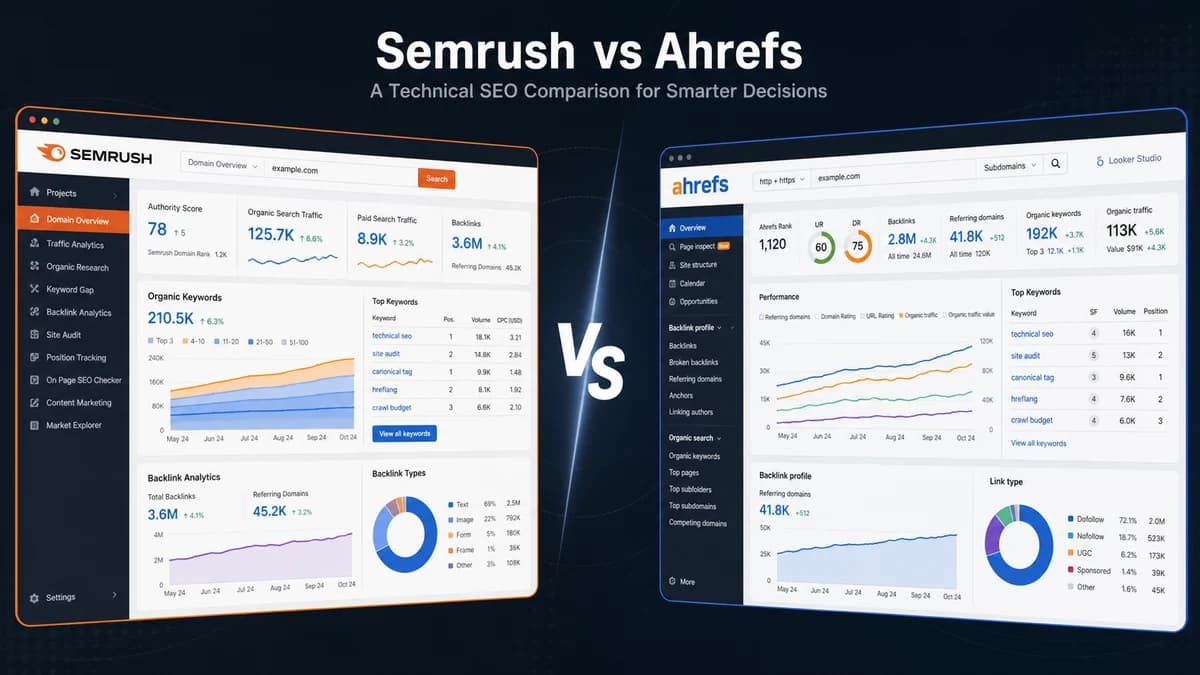
Semrush and Ahrefs both extend their SEO research products into AI visibility, but their datasets and workflows are not identical. Semrush documents visibility reports, competitor research, brand performance, AI site checks, and custom prompt tracking across supported products. Its data methodology separates its broad prompt database, weekly brand-performance data, daily custom prompt tracking, and crawl-based site audit.
Ahrefs describes Brand Radar as a discovery tool for measuring brand mentions, cited pages, competitors, and share of voice across AI and other search surfaces. Its custom prompt workflow can monitor selected assistants, locations, and refresh schedules. These tools automate parts of collection; any actual time saving needs a like-for-like record that includes review and correction. They do not remove the need to define the prompts, verify important responses, or connect a cited page to business results.
For a fuller look at the surrounding SEO workflows, read our Semrush versus Ahrefs comparison. The right question here is narrower: will the paid AI-search features change a recurring decision often enough to justify the subscription and review time?
Choose the smallest stack that can answer the business question
| Operating situation | Start with | Add paid tracking when |
|---|---|---|
| One local service business, one market, low prompt volume | GSC, Bing Webmaster Tools, analytics, lead notes, and a 10-20 prompt ledger | Manual collection regularly delays decisions or misses important competitors |
| Several services or locations | Owned reports plus separate prompt groups by service, location, and buyer stage | The team needs stable comparisons across markets and cannot maintain them reliably |
| Content or SEO team with an existing platform | Use the current tool's included AI reports and export methodology notes | Custom prompts, history, competitors, or reporting limits block the agreed workflow |
| Agency or multi-brand portfolio | A documented client-level measurement standard | Automated collection and permissions materially reduce reporting labour |
Run the free stack through one full review cycle before subscribing. If the team cannot name a decision that the added dataset will change, another dashboard will probably add monitoring work rather than clarity.
Keep one monthly measurement record
A useful monthly record can fit on one sheet. For each priority prompt or page, retain the baseline, observed signal, confidence, business implication, owner, change, and verification date. Add referral visits and qualified enquiries when the tracking supports them. Keep unavailable data marked as unavailable.
The record should also show what did not change. If a cited article has no path to the relevant service, the next action may be an internal link. If a local answer uses the wrong hours, the job may be profile consistency rather than another blog. If impressions rise while enquiries remain flat, the landing page and CTA deserve attention before content volume increases.
Google's AI features guidance keeps established Search fundamentals at the centre. There is no special AI file or schema requirement for appearing in Google AI features. The measurement stack should therefore lead back to crawlability, useful visible content, accurate structured data, business facts, page experience, and conversion paths. Our Canadian SMB GEO primer maps those foundations to retrieval, citations, answer accuracy, and business outcomes.
What a GEO Proof Lab handoff should let you inspect
A result such as “a competitor was cited” is a starting point. Before recommending a new article, we need the question, the answer, the actual source link, and the page that should address that buyer's need. GEO Proof Lab is our internal evidence workflow for keeping those records together.
The structure below explains the handoff; it is not a customer result or a measured visibility score. A scoped report should preserve the observation separately from our interpretation, including cases where the evidence does not justify a website change.
For example, if a sampled answer cites a competitor's service page, we would inspect what that page actually supports before proposing an equivalent change. Clear service coverage may be worth fixing on your site. An unsupported claim, a different service area, or a source unrelated to the buyer's task is not something to copy. The citation alone does not reveal why the model selected it.
The working output is not a larger dashboard. It is a short implementation queue with a reason, owner, acceptance check, release date, and follow-up measure. Depending on the evidence, MAXUOD may rewrite a service section, repair indexing, align public business facts, improve an internal route, specify a conversion event, or prepare a source-backed article. The completed change is then checked in the page, search tools, and measurement ledger.
Read our AI visibility baseline methodology for Canadian SMBs for the full sampling and reporting rules. For implementation, our GEO and AI search optimization services explain how findings become agreed work; our Canada-wide SEO and GEO services keep that work tied to the markets your business serves. Private Analytics or lead records require separate access, and paid or consumer-interface observations require an agreed scope.
Self-service is sensible when someone on the team can maintain the prompt cohort, interpret the reports, implement the changes, and verify them. A scoped professional project may be better value for a straightforward website when several subscriptions still leave the owner to perform all five jobs. The comparison depends on scope and internal time, not a universal price claim.
The best default for a small business
Start with Google Search Console, Bing Webmaster Tools, analytics, lead records, and a fixed prompt ledger. Review them together for one or two cycles. Add a paid AI visibility tool when repeated competitor, platform, location, or prompt analysis has become a defined operating task.
Recheck vendor coverage, report definitions, limits, and prices before purchasing because these products change quickly. Preserve the methodology with every export. A trend is only useful when you know what was measured.
Editorial disclosure: This article shares MAXUOD Digital's professional view for educational purposes. It does not provide purchasing, financial, or investment advice. No affiliate tracking links are used in this article. Product features, datasets, limits, interfaces, and prices can change; confirm them with the vendor before making a purchase.
Related reading and sources
Read next on MAXUOD
External references
Need the tools turned into a release plan?
Send MAXUOD your website and the buyer questions that matter. We will review the owned data first, identify the smallest useful measurement stack, and connect the findings to pages, implementation, verification, and the next decision.