
A page you need is missing from search
We check whether search engines can reach and read it, whether it points to the right URL, and whether the content needs attention too.
Technical SEO services · US & Canada
An important page is missing from search. The site feels slower after an update. Your audit lists problems, but nobody knows what to fix first. We investigate, make the agreed repairs, and check them with you or your developer.
Start by email. Based in Halifax, working remotely across Canada and the US. Paid work is quoted after the review.
We check whether search engines can reach and read it, whether it points to the right URL, and whether the content needs attention too.
A move, redesign or release can change links, redirects and page content. We trace the affected pages before recommending more changes.
We sort warnings by what actually needs fixing, give each task a clear owner, and explain how to check it. Some warnings can wait.
What we work on together
We check crawl and indexing controls, page responses, canonical URLs, sitemaps and internal links. Where available, your Search Console data helps us separate a technical problem from an unanswered question.
The affected URLs, what we found, and the fixes to do first.
We compare the page response with what a browser displays, then check headings, links, metadata and structured data. We also look for pages competing to do the same job.
Specific page or template changes your developer can implement and test.
We investigate slow loading with available visitor data and repeatable tests. Mobile layouts, forms and enquiry links are checked alongside speed.
Focused performance repairs and comparable before-and-after checks.
We make the agreed changes or work with your developer, check them after release, and explain what still needs time or input from your team.
A change record, completed checks and weekly progress notes.
What this looks like in practice
RMO Bearings · Public-site audit, October 18–19, 2026. Independently prepared, not commissioned client work. These are observed issues and proposed repairs; we did not implement the changes or measure subsequent growth.
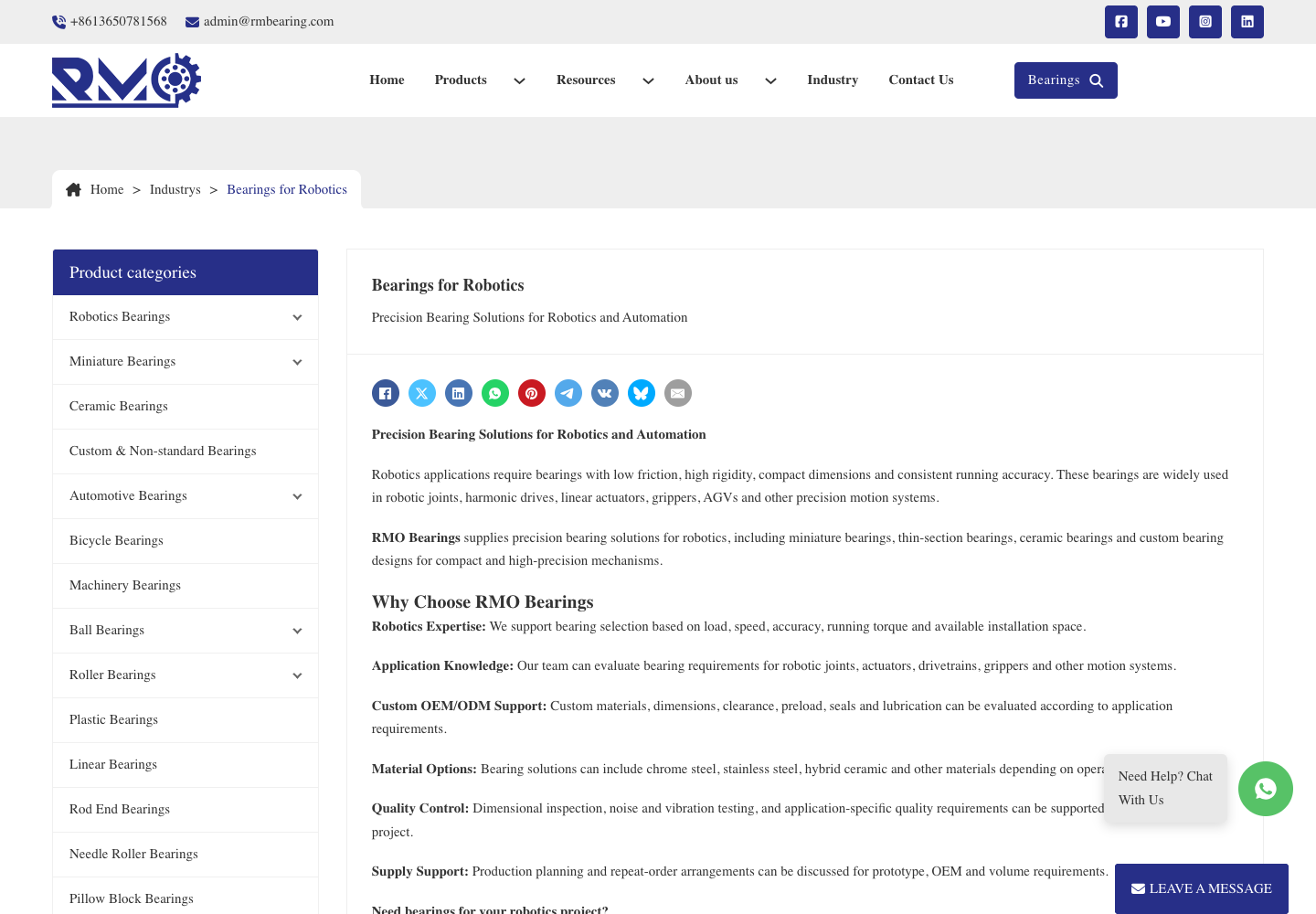
A buyer can understand an application but still has to translate it into a product choice alone. Repeated suggestions offer limited help when the relevant size, material or use is different.
The image shows one industry-page example. The counts of eight industry pages and 357 product pages come from the archived HTML and link analysis.
Read the finding and screenshot contextInspect the redirect rules and restore valid category destinations. Keep existing page URLs and pagination where the content exists.
Follow each affected link: a valid page returns 200, retains the category and shows the next products with the correct canonical.
Connect each application to suitable product families. Replace repeated related-product choices with ones relevant to the current item.
Follow each recommendation. Sample different product families and confirm the destinations change meaningfully with use, size or material.
Ask an engineer to confirm materials and dimensions, then align the category, product and guide copy with the approved facts.
Compare every revised specification with the approved source. Explain real variants and preserve the original URLs.
Working with MAXUOD
Send the website and the symptom you noticed. For an initial public-page review, we do not need passwords or administrator access.
We confirm which pages need work, who will make the changes and how we will check them. Any wider content, migration or rebuild work is scoped separately.
Changes are made in a testable environment with a rollback path. Your existing developer can implement the specification while we handle verification.
Confirm what actually shipped, then track discovery, indexation and enquiries separately. Weekly progress notes explain completed work and outstanding dependencies.
Weekly updates explain what changed, what we checked and what needs your input. They are part of the agreed work, not a separate report subscription. We only draw comparisons or test conclusions when there is enough evidence.
A few important limits
Before you decide
No. The free audit is the initial review and recommendation. Technical SEO services cover agreed diagnosis, implementation or developer handoff, and verification. You can request the free audit before deciding on paid work.
We can start with public pages. Deeper diagnosis may need read-only Search Console access, logs or a development environment; implementation needs an agreed release route. Access is requested only for the work you approve.
Yes. We can specify the issue, affected URLs and acceptance check, then review the implemented release. Direct code work depends on the stack and access agreed at discovery; we do not promise support for every platform.
No. Removing a technical block can restore eligibility, but search engines still decide whether to crawl, index and show a page. Weak or overlapping content may need a different response.
A readable, discoverable site supports the search foundation. If the next question is how AI answers describe or cite the business, our GEO service handles that separate observation and content-improvement task.
Platform guidance: Google: canonical URL signals · Google: crawlable internal links
If you’d like to read more
A self-serve guide to eligibility, rendering, performance and verification.
Decide when to improve an existing page instead of adding another one.
A Canada-focused SEO/GEO implementation case, not an independent client testimonial.
Check how AI search describes your business and improve the information behind it.
Need market-specific support? Canada-wide SEO services · Halifax and HRM SEO · US and North American delivery
A useful first conversation
Send your website, the customers you want to reach and what is worrying you. We’ll reply by email with a sensible next step. No passwords or meeting needed for the initial review.