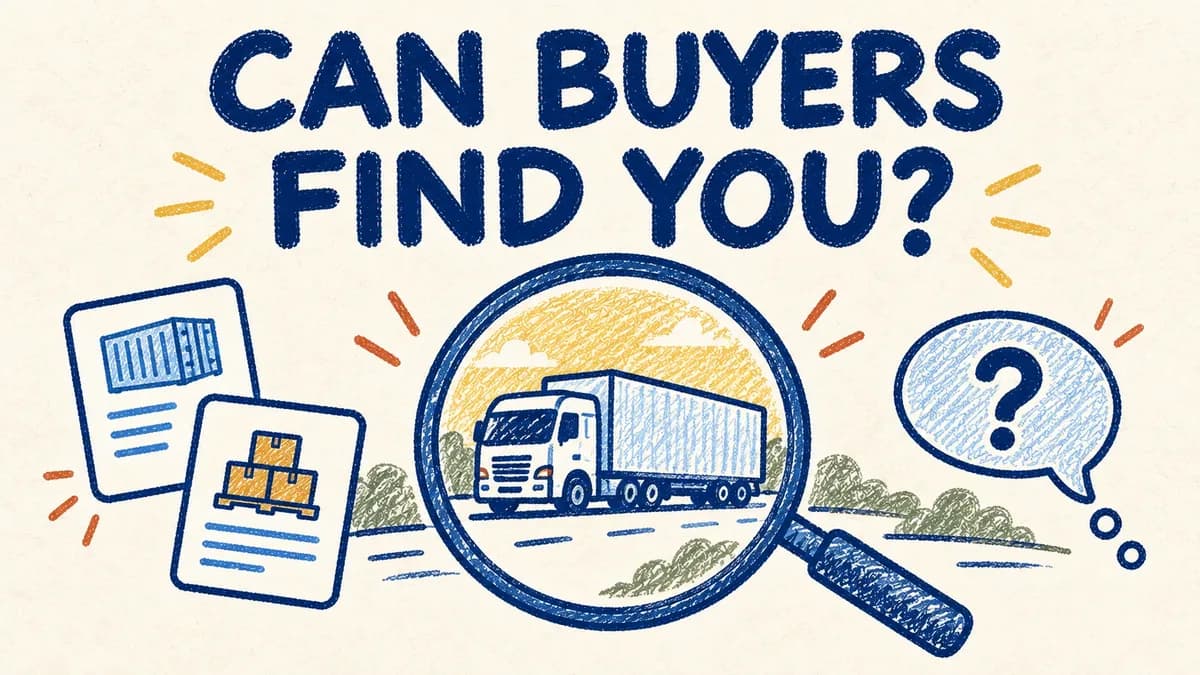
We could find the logistics business when we searched for it by name. Ask an AI system to suggest suppliers without giving it that name, though, and the expanded sample told a different story: other providers appeared; this company didn't. If a buyer hasn't heard of you yet, that is the discovery question to investigate.
This September 2026 review covered public website material and English buyer situations in Canada and the US. It is an anonymized diagnostic case. The company, its platform and the competing providers are unnamed. Identifying page details, screenshots and exact counts are withheld. We delivered an audit and recommendations; implementation and subsequent business results have not been verified.
We wanted to check the buyer who didn't know the name
When we put the company name into a question, AI answers cited its website. Often we'd supplied the URL too. Useful to know, but that gives the system a starting point an unfamiliar buyer wouldn't have.
So we also asked about buying situations, including freight coordination and cross-border shipping. No company name in the question. The business did not appear in that supplier-selection sample, although other providers did.
We had an earlier positive citation for a related question, and kept it in the report. The wording had changed. That means we couldn't call the later absence a decline or a failed campaign. Equally, we couldn't use that one positive result to say the company was consistently being discovered.
What we checked, and what we didn't
We collected repeated answers through search-enabled APIs. Separately, a search-results provider returned snapshots of Google AI Overviews. The complete captured Overviews didn't mention the company or link to its website. We kept a result with no Overview separate from an unavailable capture.
Neither method was a signed-out consumer-browser test. We wouldn't tell a business these were the answers every ChatGPT or Perplexity user sees. The Google snapshots and API answers stayed separate, with the question, market context and collection time saved for each.
We chose questions to investigate the offer. They're a research set, not a verified search-demand dataset. Repeating them helps us see whether answers change; it doesn't give us more customers. We didn't have Search Console, Analytics or enquiry records, so we couldn't tell the company how much business these answers brought in.
Some pages were telling a different story
Following the homepage links led us to unrelated template content and a broken destination. We also looked beneath the visible layout, at the page HTML, and found wording that didn't match the main service explanation. Some AI descriptions repeated similar wording.
That was a reason to review the content, not to accuse the business of offering something it couldn't deliver. Matching words don't tell us exactly where an answer came from. We'd first ask the business which responsibilities and service descriptions were current.
We found missing search descriptions and canonical links in the initial HTML we checked. The common sitemap addresses didn't return a usable sitemap either. We followed public links; this was not a complete CMS inventory or an indexing report.
We'd repair those issues without claiming they'd explain every missing AI citation. Google says a sitemap helps discovery but doesn't guarantee indexing. Its canonical guidance also explains that Google can choose a preferred URL without that tag. Our immediate concern was simpler: stop sending people to conflicting or unfinished material.
The right comparison depended on what the buyer needed
A buyer choosing shipping software isn't necessarily choosing a customs specialist. Both can appear in the same AI answer, along with a carrier, a government page or an industry publication. Counting every source as a competitor would give the company a misleading picture.
We looked at what each cited page helped someone decide. A service-specific page might explain who a provider works with. Another might clarify a handoff or show how to ask for help. Those are useful things to learn from a comparison, even if that provider also works as a partner in another situation.
For this business, we'd use that review to clarify which shipping needs it can handle and what the customer should expect. The team would need to confirm which needs matter most to its customers. More citations for another provider don't prove better service or more revenue.
MAXUOD adds: what we'd put first
We wouldn't start by ordering more general logistics articles. First, we'd confirm the offer and clean up the pages already online. Otherwise, new content could repeat an unsettled claim or lead a buyer back to the same unfinished destination.
This is where our technical SEO work and GEO service meet: make the source reliable, then review how search systems use it. Google's AI-features guidance points to the same search foundations for AI Overviews and AI Mode. No special AI markup can replace a service explanation the business can stand behind.
If we move into implementation, the weekly update should let the business see what changed and what we've checked. A task isn't done because it appeared in our report. We'd verify the live page and make the next decision from there.
Where we'd go next
The audit gave the business a starting point: the discovery gap we'd observed, the website information to review and the work we'd prioritise. It didn't explain every reason behind the AI answers. It also didn't show lost customers or promise that a fix would earn a citation.
After approved changes, we'd check the website again and repeat an agreed set of buyer questions. We'd look at the accuracy of the descriptions as well as the links. Visits and qualified enquiries would need their own records. For another logistics business, we'd start with its services, country and language, rather than hand over this company's question set.
Related reading and sources
Read next on MAXUOD
External references
Can buyers find you before they know your name?
Send us your website, target country and language. We can look at the starting problem with you, then agree on what to investigate and what needs fixing.