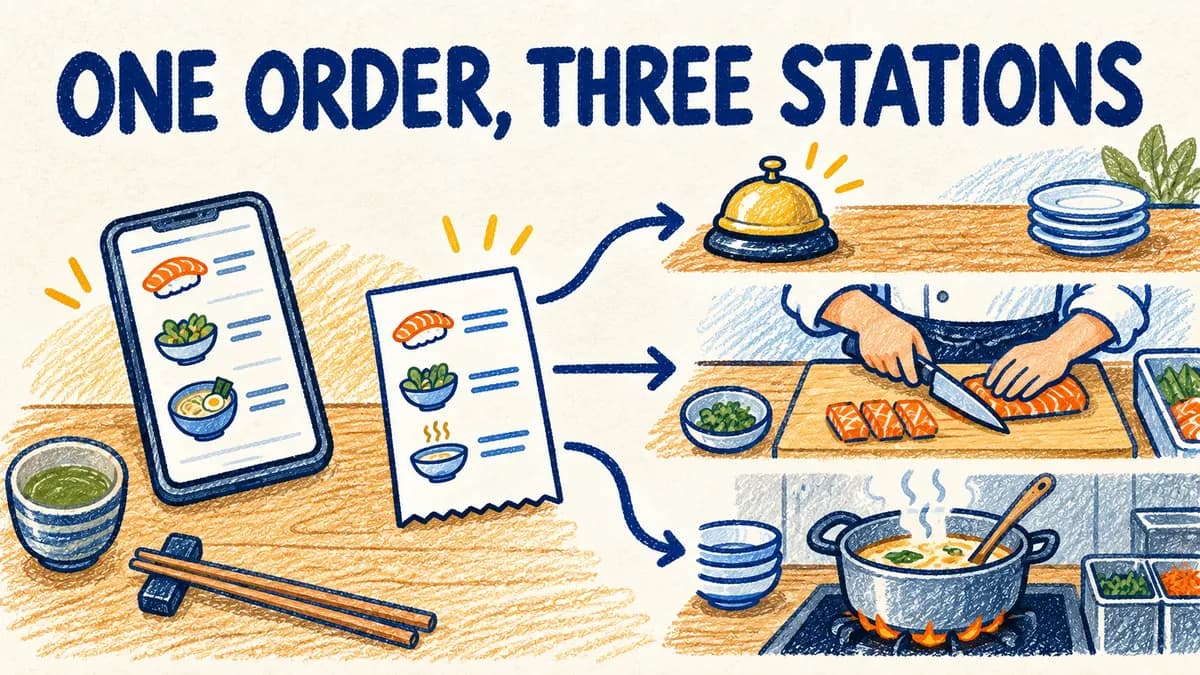
MAXUOD Digital is building a mobile-first online ordering and restaurant operations system for JUKAI Japanese & Thai in West Bedford. The work connects a refreshed customer website and direct ordering experience with a touch-first staff workflow, store coordination, and station-specific printing.
This is an implementation case, not a performance claim. At the September 4, 2026 review recorded here, the customer and staff experiences were in staged testing and controlled pilot preparation. Payment reconciliation, cloud operations, live multi-location use and external delivery-platform connections had not passed the production gates. This page does not assert their current release status.
The brief started with JUKAI's service flow
A generic restaurant template can display a menu and collect a simple order. JUKAI's workflow asks for more. A customer may choose pickup or delivery, select a location, order a combo, replace one or more included rolls, add preparation options, and expect the price and kitchen instructions to stay clear.
The staff side carries different pressure. Servers need to find dishes quickly on a tablet, record a detailed substitution without relying on memory, and send the right information to the front counter, sushi bar, and kitchen. The order must keep its identity as it moves between those stations.
We used JUKAI West Bedford's public pickup menu as the working menu source, then shaped it into a controlled staging snapshot. The reviewed staging snapshot contained 215 items across 24 categories, with one structured price source and explicit option surcharges. Restaurant review is still required before any menu or price becomes a live store record.
The customer website and ordering flow have separate jobs
The restaurant website should answer the questions that come before an order: what JUKAI serves, which location the customer is choosing, when that location accepts orders, and how pickup or delivery works. The ordering interface then takes over for menu browsing, customization, bag review, and fulfilment details.
On a phone, the customer starts by confirming pickup or delivery and the selected location. They can browse the full menu, move between categories, open an item, and review the bag without losing their place. Changing location or fulfilment mode prompts a deliberate bag check because a menu item or price may not carry cleanly to another store.
JUKAI's combo logic is where a standard ecommerce cart stops being enough. The interface lets a customer customize included sushi rolls one by one, shows the replacement and surcharge, and preserves that choice as structured order data. The same approach supports preparation choices and notes without turning every request into an unstructured text field.
The staff interface follows the menu, not a generic grid
Large touch targets and short menu paths matter during a busy shift. The staff interface uses category navigation, dish abbreviations, fast search, and immediate visual feedback so a server can build the order while still talking to the customer.
Menu rules are encoded in the workflow. Roll substitutions, combo upgrades, preparation options, surcharges, and station-routing decisions remain attached to the order. Staff do not have to calculate a known surcharge by hand or rewrite a structured change as a kitchen note.
The staging interface also includes customer lookup, member points, store credit, discounts, reserved orders, and cash-checkout flows. These modules show how the wider operation can fit together, but member and credit data remain prototype data until production identity, migration, privacy, and reconciliation controls are approved.
One order becomes the right ticket for each station
The local Store Hub coordinates orders from staff tablets and prepares separate jobs for the front counter, sushi bar, and kitchen. Each ticket keeps the order number, selected items, preparation details, and notes needed by that station. The staff interface can switch between English and Simplified Chinese, and the print path has dedicated Chinese-encoding tests.
That distinction matters: software tests can confirm that a print job was created, claimed, and sent to a device. They do not prove that every physical printer produced the right paper ticket during a live shift. Cutter completion, drawer movement, disconnect recovery, and multi-printer routing still need observed in-store tests.
Local reliability comes before cloud expansion
The system uses React and TypeScript for the customer and staff interfaces. A local SQLite coordinator gives staff tablets one order record, server-owned versions, duplicate-submit protection, an audit trail, and a print queue on the restaurant network. Orders and queued changes can remain available locally when a cloud connection is interrupted.
A private Supabase staging foundation adds organizations, locations, menu versions, orders, members, ledgers, print attempts, and synchronization records. The architecture is being prepared for more than one location, but the additional customer locations were sample interface states at that review. Live multi-location operation has not been claimed.
JUKAI's existing Clover hardware is treated as a separate payment system. We have built a sandbox reconciliation contract around stable order and provider references; no live Clover application, terminal credential, card transaction, or production correlation has been verified. Uber Eats, Skip, and DoorDash are also future integration paths, not active connections in this case.
What MAXUOD contributed
MAXUOD mapped the customer, server, counter, sushi-bar, kitchen, payment, and printing handoffs before committing to the system shape. That work produced the mobile ordering flow, touch-first staff experience, menu and modifier model, deterministic station routing, local coordination service, cloud staging foundation, and a testable boundary around provider integrations.
The project also includes the less visible work that determines whether a restaurant system can be trusted: duplicate-submit protection, version-conflict handling, offline queues, immutable event records, private-data limits, printer-job states, and production-entry gates. Those controls are part of the product, even though a customer never sees them on the menu screen.
The verified result stops at implementation
The customer journey, combo and roll customization, bag recovery, delivery-area handling, structured order intake, staff sign-in, order versioning, offline replay, and print-job state changes have automated test coverage. Browser checks confirm that the main customer and staff screens render and can complete their staging flows.
No revenue lift, commission saving, labour reduction, order-volume increase, or return on investment is attributed to the system. Those outcomes require an approved production launch, a dated baseline, a useful observation window, and JUKAI's permission to publish the data.
Status at the September 4 review: This project is undergoing staged testing and deployment preparation. Payment reconciliation, cloud operations, physical printer behaviour, live ordering, and external delivery-platform connections must pass controlled validation before production use.
What this project shows other small businesses
Custom software is justified when the workflow itself is part of the service. A menu card is only the first surface in this project. The harder job is keeping a detailed order accurate as it moves from a customer's phone or a server's tablet to the correct station, payment record, and later customer history.
An off-the-shelf product remains the better choice when it fits the menu, routing, payment, and reporting requirements without a web of workarounds. A custom build becomes useful when those workarounds create repeated errors, double entry, unclear ownership, or a customer experience the business cannot shape.
For a restaurant, retailer, clinic, trades company, or service firm, the same rule applies: map the work first. Build the smallest connected version that can be tested. Expand only after the operating gates pass.
项目简介
MAXUOD Digital 为 JUKAI Japanese & Thai West Bedford 门店设计并开发了一套手机优先的在线点餐与餐厅运营系统。顾客可以浏览菜单、自定义套餐与寿司卷、选择自取或配送,并查看门店接单时间。员工端采用适合平板和触摸屏的界面,支持菜品定制、会员与店内 Credit 原型、预留订单、现金结账,以及前台、寿司吧和后厨的结构化分单。
在 2026 年 9 月 4 日记录的审查中,项目处于分阶段测试和受控试点准备阶段。多门店架构、云端同步、Clover 对账及 Uber Eats、Skip 和 DoorDash 等平台连接仍需完成生产验证,因此本案例不把测试系统描述为已经全面投入营业。
Case note: Project scope and implementation status were reviewed on September 4, 2026. This page documents MAXUOD's product and engineering work. It does not promise that another business will receive the same operational or commercial result.
Related reading and sources
Read next on MAXUOD
Does your business workflow need a custom system?
Show us the handoffs, workarounds, or customer flow that existing software does not handle. We will help you decide whether to keep the current tools, connect them, or scope a focused build.