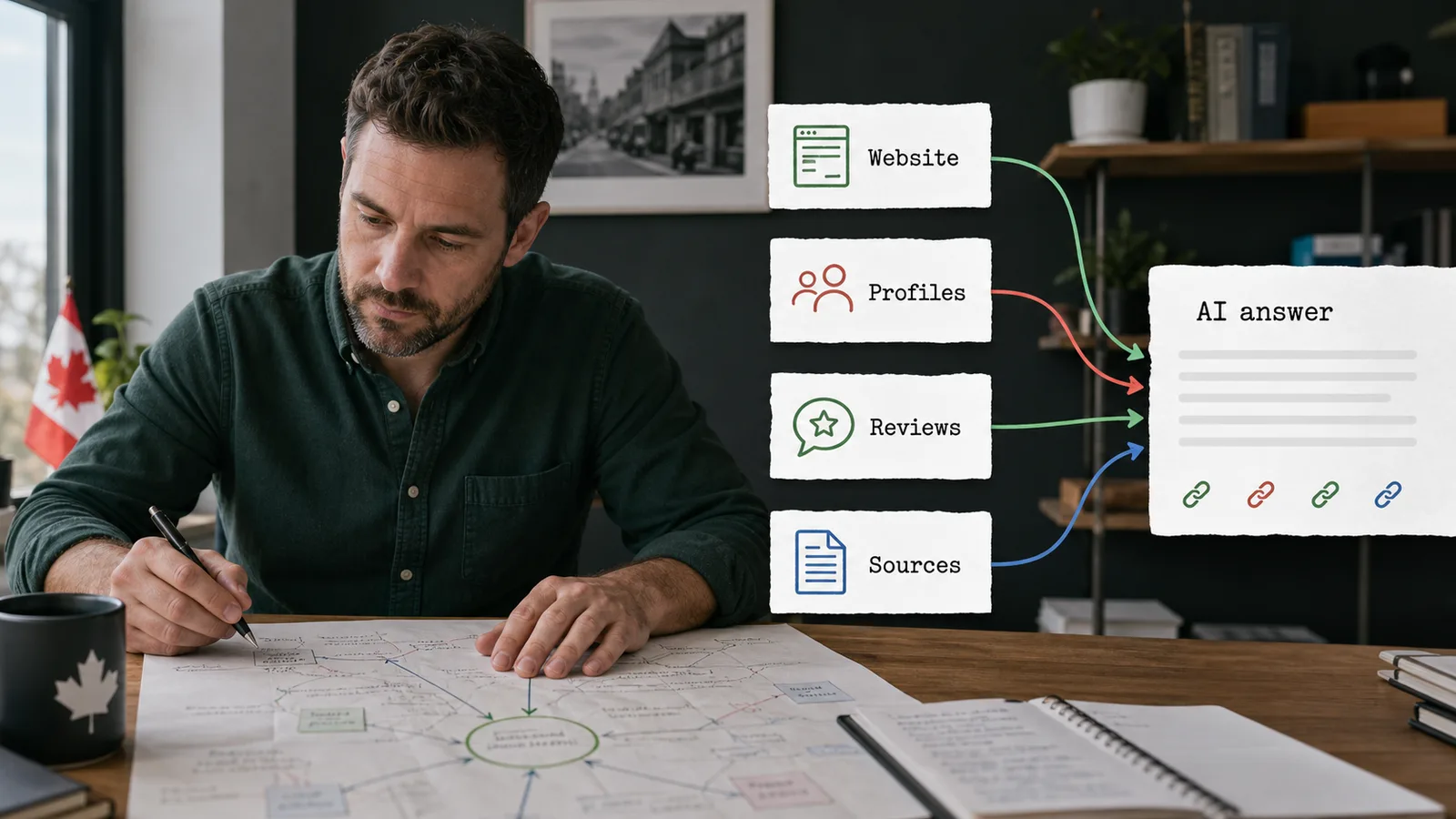
A good generative engine optimization agency in Canada should help your business become easier for AI search systems to find, understand, cite, and recommend. For most small businesses, that means fixing the SEO foundation first, then adding answer-ready content, clearer entity signals, stronger local proof, and a repeatable way to monitor AI mentions and citations.
The wrong purchase is a vague "AI visibility" package with no crawl audit, no content plan, no source review, and no measurement beyond screenshots of prompts. GEO is useful, but it works best when it is tied to the same business outcome as SEO: qualified customers finding enough trustworthy information to contact you.
What GEO Means in Plain English
Generative engine optimization, often shortened to GEO, is the work of making your website and public presence easier for AI-powered search tools to use in generated answers. That includes Google AI Overviews and AI Mode, Bing Copilot-style answers, Perplexity, ChatGPT search experiences, and other answer engines that retrieve sources before writing a response.
GEO does not replace SEO. Google says standard SEO work remains relevant for its AI features. Bing's 2026 AI Performance preview also points in the same direction: AI visibility depends on whether pages are discoverable, useful, clear, current, and trusted enough to be cited.
What Canadian GEO Service Pages Usually Promise
An agency page may explain GEO, list platforms and display a prompt screenshot. That still leaves the buying question unanswered: what will the team inspect, change and verify for your business? Ask for those deliverables before comparing retainers. A large company's monitoring programme and a small provider's first source correction are not the same scope.
A large SaaS company might need enterprise prompt monitoring, share-of-voice reporting, analyst relations, review-site strategy, and multi-market content operations. A Halifax trades company, clinic, restaurant group, or professional service firm usually needs a tighter first phase: make the business facts consistent, make the core service pages answer real buyer questions, and measure whether AI tools can understand the business correctly.
The First Thing to Buy: Foundation Before Dashboards
If your website has weak service pages, missing metadata, poor local signals, slow mobile performance, thin buyer-question content, or inconsistent profiles, a GEO dashboard will mostly show that you are invisible. That can be useful, but it is not the highest-impact first spend.
Start with a combined SEO and GEO foundation audit. It should check:
- whether important pages are indexable and in the sitemap
- whether titles, descriptions, H1s, canonicals, and internal links support the right page intent
- whether service pages clearly explain the offer, audience, geography, process, proof, and next step
- whether supported structured data accurately describes visible business and page facts; do not include retired FAQ rich-result tactics as a default service deliverable
- whether Google Business Profile, Bing Places, Apple Business Connect, LinkedIn, directories, and review profiles describe the business consistently
- whether AI crawlers and normal search crawlers are accidentally blocked
- whether the site has enough source-backed content for AI tools to summarize confidently
This is not glamorous work, but it is the part that makes the rest of GEO possible.
The Second Thing to Buy: Answer-Ready Content
AI search systems need extractable answers. That does not mean stuffing the page with keywords or adding fake FAQs. It means writing pages that answer the questions a buyer would ask before contacting you.
For a Canadian small business, useful answer-ready content often includes:
- a direct definition of the service in the first section
- who the service is and is not for
- service-area details such as Halifax, Dartmouth, Bedford, Nova Scotia, Atlantic Canada, or Canada-wide remote work where true
- pricing factors without fake precision
- process steps and timelines
- comparison tables that help customers choose between options
- buyer-question sections with one clear answer per question
- external sources when the article discusses laws, taxes, health, finance, platform changes, or technical standards
The best GEO content is still written for people. It is simply structured so search and AI systems can reuse the facts without guessing.
The Third Thing to Buy: Measurement That Matches Reality
Traditional SEO reporting usually starts with rankings, impressions, clicks, and conversions. GEO reporting adds a different set of signals: whether AI tools mention the brand, which competitors appear instead, which URLs get cited, what the answer says, whether the sentiment is accurate, and which prompts create visibility.
Bing's AI Performance report gives a platform-owned record of citation activity, with limits on what counts and what the sample covers. Paid trackers add other collections and workflows. Before buying one through an agency, ask which source each metric comes from, whether collection uses an API or consumer interface and whether the underlying answer can be inspected. Brand mentions, citations, referrals and qualified enquiries should not become one score.
For a small business, the minimum useful measurement loop is simpler:
- Choose 10 to 20 prompts that match real customer questions.
- Run them monthly across the AI search tools your customers likely use.
- Record whether your business, competitors, directories, government pages, or publishers are mentioned.
- Record cited URLs when the tool shows sources.
- Fix the page or profile that should have answered the prompt better.
- Track form submissions, calls, bookings, and "how did you hear about us" answers alongside AI visibility.
What to Ask a GEO Agency Before Signing
Use these questions before buying a GEO package:
| Question | Why it matters |
|---|---|
| Will you audit crawlability, indexation, service pages, schema, and local profiles first? | GEO needs a clean SEO foundation. |
| Which AI search surfaces do you monitor? | ChatGPT, Perplexity, Gemini, Claude, Bing, and Google surfaces behave differently. |
| Can I see the prompt list? | Prompts should match buyer questions, not just vanity keywords. |
| Do you track cited URLs and competitor citations? | Mentions without source analysis are hard to act on. |
| How will you improve pages after the audit? | The report is not the outcome; better pages are. |
| What claims will you not make? | No serious agency should guarantee rankings or AI citations. |
| How do you handle Canadian local, bilingual, or province-specific context? | Canadian SMBs often need location and jurisdiction clarity. |
What Not to Buy
Do not buy a GEO service that treats one manual prompt check as a stable ranking. AI answers vary by model, location, wording, freshness, personalization, and retrieval behavior. A single screenshot can show a problem, but it is not a complete measurement system.
Do not buy hidden FAQ schema, mass-produced AI articles, fake review campaigns, or forum spam. Those tactics create reputational and search risk. Google requires structured data to match visible page content, and real communities do not respond well to obvious promotion.
Do not buy GEO as a replacement for local SEO. For a Canadian local business, Google Business Profile, Bing Places, Apple Business Connect, reviews, citations, local service pages, and regional links still matter. AI systems need those same public facts when answering location-specific questions.
Agree on three handoffs you can accept or return
A diagnosis before editing. The first record should name the priority pages, buyer questions, market and language, current source facts, access conditions and missing evidence. Freeze the baseline before a material change when it is safe to do so. An urgent security or broken-enquiry repair should not wait for a perfect experiment.
An implemented change, not a recommendation count. Agree which page or public record will change, who approves its facts, who implements it and what the acceptance check is. A corrected service explanation, repaired access rule or verified contact route is a deliverable. “Improved AI trust” without an inspectable change is not.
A follow-up with the same definitions. Repeat the agreed sample after a justified observation window. Keep concurrent changes, failures and unknowns visible. The agency should be able to report no material movement without relabelling the cohort or turning an ordinary mention into a win.
These handoffs form the first scope. Ongoing content, source development or monitoring should follow the evidence and the team's capacity—not be included merely because the proposal calls it a monthly programme.
Where MAXUOD Fits
MAXUOD treats GEO as a visibility layer built on SEO foundations. For Canadian SMBs, we usually start with the pages and profiles closest to revenue: homepage, service pages, location/service-area pages, Google and Bing profiles, schema, FAQs, internal links, and measurement. Then we add content that answers the questions customers and AI systems are already asking.
The goal is not to chase every new acronym. The goal is to make your business easier to understand, easier to trust, and easier to recommend wherever customers search next.
Related reading and sources
Read next on MAXUOD
External references
Want to know what GEO work is actually worth doing?
Send your site and we will review the SEO foundation, AI-answer readiness, local signals, and the first prompts worth monitoring before recommending a retainer.