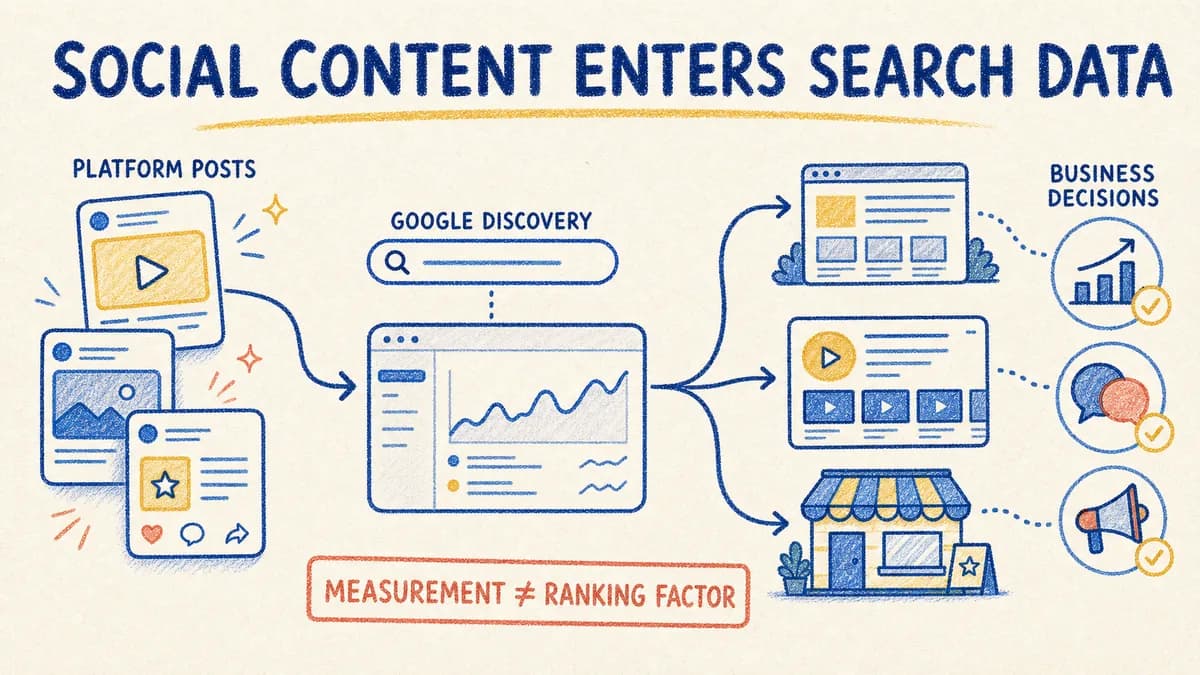
Google completed the global rollout of Search Console platform properties on July 29, 2026. A business can now verify supported Instagram, TikTok, X, and YouTube accounts, then see which posts, videos, and queries earn visibility through Google Search. Discover and Google News data can also appear when the content is eligible for those surfaces.
This expands the boundary of SEO reporting beyond the company website. It does not establish likes, shares, followers, or social engagement as Google ranking factors. Google describes platform properties as a way to measure performance, and its property setup documentation says adding a property does not affect how that property performs in Search.
MAXUOD's view: social content is likely to receive more weight in SEO planning, reporting, and budget allocation because its Google discovery is now measurable at the post and query level. That is portfolio weight, not a confirmed change to Google's ranking formula.
Google moved the reporting boundary beyond the website
Search Console began as a place to inspect owned websites. Platform properties add accounts hosted on domains the business does not own. Each supported account becomes its own property, with Performance, Insights, and Achievements reporting.
Google's July 29 rollout notice says the feature is globally available. Its accompanying social and video performance guide recommends using query groups, a 24-hour filter, country and device data, URL filters, format comparisons, cross-property exports, and annotations for title or caption changes.
The reporting boundary still matters. According to the platform-property help page, Search Console shows how supported content performs across Google. It does not report how many people saw a post inside TikTok, Instagram, X, or YouTube. A video click can also count when it opens inside Google's viewer, so a Search Console click is not always a visit to the creator's website or even to the platform's normal page.
LinkedIn and Facebook are not in the current supported list. Accounts must be verified separately, new data can take several days to appear, and the first chart may cover only the period after the property was created. Those limits should sit beside every early comparison.
Practitioners agree on the direction, not on a ranking claim
The strongest practitioner reactions focus on discovery and measurement. None of the sources reviewed for this article showed evidence that social engagement metrics had entered Google's documented ranking systems.
Aleyda Solís: SEO no longer ends at the website
Aleyda Solís argued that the release makes fragmented discovery harder to ignore. Her point is broader than adding another report: SEO work should follow the places where an audience searches, rather than assuming every discovery task starts on Google and ends on a brand-owned page.
That reading supports cross-channel planning. It does not mean Search Console measures discovery inside AI answers, private communities, platform-native feeds, or word of mouth. Platform properties measure supported content when it appears through Google's surfaces.
Lily Ray: search-everywhere measurement has arrived
Lily Ray described the change as “search everywhere optimization” extending into measurement. The useful part of that phrase is the word measurement. Teams can now see Google queries and post-level results for assets that previously sat outside a normal website property.
The phrase should not become permission to optimize every channel for the same keywords. A YouTube tutorial, an Instagram Reel, an X post, and a service page solve different reader tasks. Search-everywhere planning works only when each format keeps its native job.
Brodie Clark: useful data can still begin as partial data
Brodie Clark reported that the earlier YouTube social-channel experiment produced useful information. After receiving platform-property access for X, he also noted that the initial Discover view contained only one day of data and surfaced image URLs from a specific post.
That early observation is a good operating warning. A new property may expose assets and URL patterns the team did not expect, while the short initial date range can make one post look more representative than it is. Export first. Label the partial window. Wait before moving budget.
Barry Schwartz: a non-owned domain can now become a verified search asset
Barry Schwartz focused on the novelty of verifying and measuring content hosted on domains the publisher does not own. That changes the reporting model. A social or video account can now have a search-performance owner, query history, content rows, and annotations in the same tool SEO teams already use.
It does not turn the account into owned infrastructure. The platform still controls the URL, interface, access rules, format, and distribution inside its own product.
Rand Fishkin: not every channel needs to send a direct click
Rand Fishkin's comments predate this release, but they help explain its budget implications. In a December 2024 interview, he recommended finding the sources that influence customers instead of treating Google rankings as the only marketing task. He also argued that brand, PR, events, social activity, and other investments can create branded search demand that teams later misattribute to SEO alone.
Platform properties do not solve that attribution problem. They make one section of the journey visible: Google discovery of supported platform content. The later branded search, website visit, direct enquiry, or in-platform action still needs separate evidence.
Social can gain SEO weight in four different ways
More search inventory becomes measurable
A website page is no longer the only brand-controlled content row an SEO team can inspect in Search Console. A post, video, channel page, playlist, Reel, or Short may earn Google impressions and clicks. The business can now compare those assets without pretending they belong to the website property.
Query research can start with a platform post
A video or post may reveal language that never appears in the website property's query data. That does not automatically justify a new article. The query may be better answered by extending the video, revising a caption, pinning an older post, or connecting the asset to an existing service page.
Content budgets can follow format fit
A repeated group of qualified queries can show that one format fits a customer task better than another. Demonstrations may suit video. Timely commentary may suit a short post. Detailed comparisons, terms, service boundaries, and conversion paths usually need an owned page. The allocation should follow observed task fit, not the availability of a new dashboard.
Search visibility can rise without website traffic rising
A person may click a video in Google's viewer, recognize the brand, and search for it later. Another person may contact the business inside a platform. Search Console can record the first click without proving the later effect. For some businesses, total Google visibility could grow while website organic sessions stay flat or decline.
This is the channel shift businesses need to watch. It is a change in where the customer consumes evidence, not proof that the website has stopped mattering.
Which businesses may see their traffic mix move first?
| Business pattern | Likely first shift | Keep on the owned website | Evidence before reallocating |
|---|---|---|---|
| Visually demonstrable local services, hospitality, retail, or personal care | More Google discovery may land on short videos, image-led posts, or profile assets | Service area, booking path, prices or quote conditions, policies, and durable proof | Repeated local queries, platform clicks, in-platform actions, branded searches, and qualified enquiries |
| Tutorial, software, education, or specialist knowledge businesses | YouTube videos, Shorts, playlists, and channel pages may own more how-to discovery | Documentation, product detail, comparisons, accessibility, contact, and conversion measurement | Query clusters by format, country, device, watch data from YouTube, referrals, and later business actions |
| News, events, commentary, and trend-sensitive brands | X posts or short video may capture time-sensitive searches before a durable page is justified | Stable analysis, event details, source record, offer, and an archive that remains available | 24-hour spikes separated from sustained demand, plus annotations for follow-up content |
| Professional, regulated, or high-consideration services | Social may support discovery, familiarity, and proof more than final conversion | Qualifications, scope, limitations, privacy, process, detailed answers, and the enquiry path | Qualified lead source, assisted branded demand, content accuracy, and a longer review window |
These are routing hypotheses, not sector forecasts. A restaurant with strong YouTube tutorials may behave differently from another restaurant that wins through Maps and branded searches. A software company may find that one founder's X posts outperform its video channel. The property data should decide which case applies.
Do not move the company onto rented land
Platform properties make rented channels easier to measure. They do not give the business ownership of the channel, URL rules, distribution system, audience access, or historical availability.
The company website remains the best place for durable business facts, service boundaries, conversion paths, privacy choices, accessible long-form information, internal links, and evidence that must remain available after a platform changes its interface. Social and video assets can earn discovery and demonstrate the work. The website gives that attention somewhere stable to resolve the buying decision.
The rational model is a portfolio. One content idea can have one canonical explanation on the website, one useful demonstration on video, and a smaller platform-native version where the audience already spends time. Repeating the same article word for word across four accounts adds little. Each asset should have a job and a measurement owner.
Move resources only after the properties produce comparable evidence
- Add each eligible account separately. Record the verification date and expect the first reporting window to be partial.
- Keep the fields consistent. Export property, platform, content URL, query or query group, Google surface, country, device, format, clicks, impressions, CTR, position, and observation dates.
- Assign query groups to the best owner. The right owner may be an existing website page, a YouTube video, an Instagram or TikTok demonstration, an X post, or no new content.
- Annotate one meaningful change at a time. Record title, caption, format, cross-promotion, or content updates, then compare a useful before-and-after window without claiming causation from one spike.
- Pair discovery with business evidence. Use platform-native analytics for in-platform reach and actions, website analytics for visits and consented events, and actual forms or emails for qualified enquiries.
- Reallocate only when the pattern repeats. Two comparable 28-day windows are a defensible default for ordinary content. Seasonal or news-led content needs a window that matches its shorter demand cycle.
Do not add website clicks and platform-property clicks into one “organic growth” total. The content, destination, user action, and business value differ. A larger total can hide a weaker enquiry path.
From four properties to one content decision
Search Console supplies the rows. MAXUOD would connect those rows to the business decision: which service the query concerns, which market it comes from, what format answers it well, which asset already owns the topic, and whether the next action is to update, repurpose, create, or wait.
The deliverable is a cross-property decision ledger, not another blended score. Each meaningful query group receives a content owner, a reason, an implementation task, an acceptance check, and a later review date. Website work, social work, and video work can then compete for resources using the same business criteria while keeping their measurements separate.
A small team can run this process in a spreadsheet. A focused review becomes useful when several accounts, markets, formats, and page owners create duplicate work or conflicting reports. The value is not access to Search Console. It is deciding what the evidence changes and shipping the smallest useful update.
What would change our recommendation?
Our current recommendation is conservative: verify the accounts, establish separate baselines, and let repeated query and business evidence change the content mix. Keep the website as the stable business owner. Increase social or video investment where the platform property shows qualified Google discovery and the native analytics show that people consume or act on the content.
We would change that recommendation if Google documents a new ranking relationship, if supported platforms expand materially, or if a company's own data shows that platform content consistently captures valuable queries and assists qualified outcomes better than its current website-first allocation. We do not know yet how the global rollout will redistribute traffic by industry or how much platform clicks will replace website clicks.
The immediate shift is simpler. Search teams can no longer dismiss social and video as unmeasurable brand activity when those assets appear in Google. Social teams can no longer treat in-platform reach as the whole discovery picture. Both teams now share a new dataset. They still need judgment before sharing a budget.
Editorial and measurement note: This article is MAXUOD's professional analysis for educational purposes. Google documentation and practitioner commentary were checked on July 31, 2026. Platform availability, supported accounts, interfaces, and reporting definitions may change. Platform-property data does not by itself establish ranking causality, attribution, traffic growth, or qualified enquiries.
Related reading and sources
Read next on MAXUOD
External references
Should social, video, or the website own the next search opportunity?
Start with the free SEO and GEO audit. MAXUOD can inspect the current pages, platform assets, query ownership, tracking, and enquiry path before recommending where the next content budget should go.