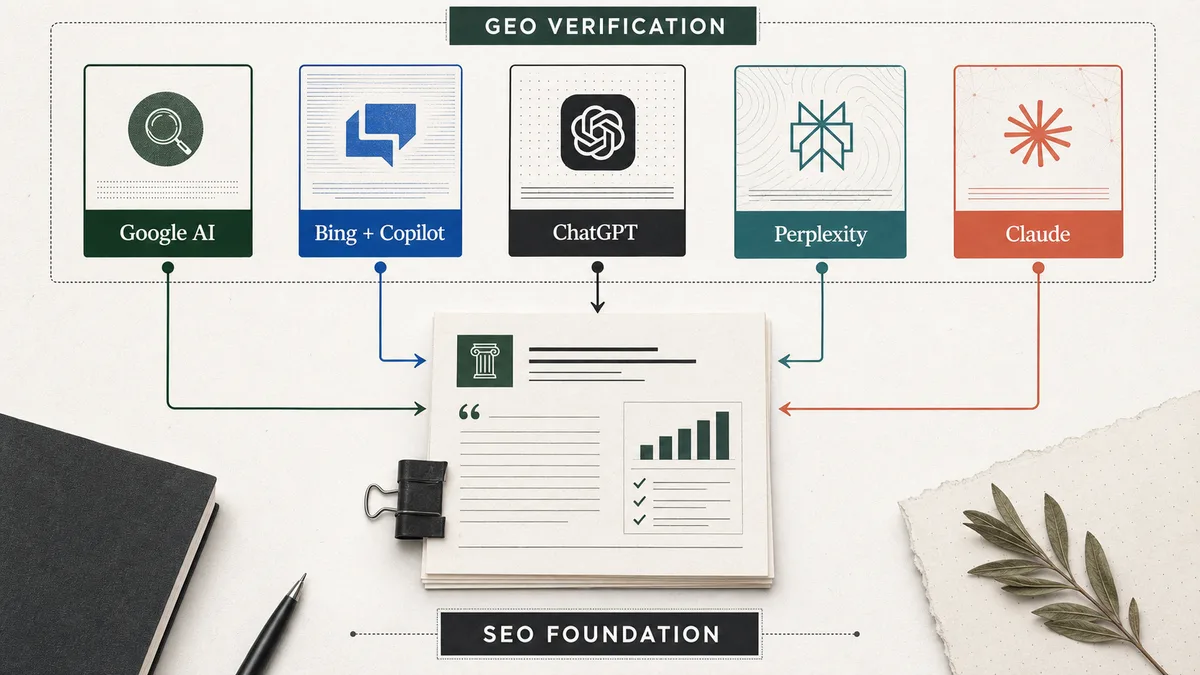
A page does not become GEO content because its answers are shorter, its headings are questions, or the phrase “AI search” appears in the brief. A sound GEO article is still a sound SEO article. The difference is that the brief now has to account for retrieval, synthesis, citation, entity consistency, and platform-specific verification.
That distinction matters because the major answer platforms are not one channel with five logos. Google AI Overviews and AI Mode sit inside Google Search. Bing exposes citation data across supported Microsoft AI experiences. ChatGPT, Perplexity, and Claude document different search and crawler controls. Their reports are not equivalent, and some do not offer publishers a performance report at all.
Our view is firm: write one authoritative page for the reader and its owned intent, then validate that page across the relevant retrieval surfaces. Publishing a Google version, a ChatGPT version, and a Perplexity version of the same argument usually creates duplication before it creates visibility.
GEO changes the brief, not the species of article
SEO answers a basic publishing question: does this page deserve to exist for a specific reader need, and can search engines find, understand, and rank it? GEO adds another question: if an answer system retrieves this page, can it reuse the right claim without dropping the qualification, choosing the wrong entity, or citing an obsolete URL?
| Brief decision | SEO foundation | GEO addition |
|---|---|---|
| Demand | Query family, intent, audience, and page owner | Prompt tasks, follow-up questions, comparisons, and likely retrieval paths |
| Evidence | Original experience, useful facts, authoritative sources, and accountable authorship | Claims that remain accurate when extracted, with source, date, scope, and qualification close by |
| Structure | Clear headings, readable sections, internal links, and a complete human argument | Self-contained passages and unambiguous entities without forcing every paragraph into a fixed length |
| Authority | Relevant links, reputation, expertise, reviews, and useful site coverage | Consistent facts and descriptions across owned pages and credible third-party sources |
| Measurement | Indexing, rankings, impressions, clicks, enquiries, and qualified outcomes | Citations, mentions, answer accuracy, cited URLs, prompt samples, monitoring-task observations, and AI referrals where the platform exposes them |
The added review work does not replace search fundamentals. Google's current guide retains indexed, snippet-eligible pages and useful content as the foundation. Its Search generative AI control also governs inclusion: inclusion is the default, while a property's inherited or explicit exclusion can make the content ineligible for the listed AI features. Check the control without inventing an extra AI file, schema or writing formula.
One page meets five different evidence surfaces
There is no honest “optimize for every AI” switch. There is a shared content system and a set of platform checks. For this briefing, we are looking at five major discovery surfaces. We group Google's Search AI features together and do not treat the Gemini app as if it were another view inside Search Console.
Google AI: SEO eligibility remains the gate
Google says AI Overviews and AI Mode may use query fan-out, issuing related searches across subtopics and sources before producing a response. That changes topic planning. A narrow page may need stronger supporting coverage, clearer internal routes, and answers to adjacent tasks that belong to the same reader journey.
It does not justify one page per fan-out phrase. Google's newer generative AI optimization guide explicitly warns against producing separate content for every query variation primarily to manipulate search or generative responses. The better response is a coherent owner page supported by genuinely distinct articles.
The dedicated Generative AI performance report completed its worldwide rollout on August 31, 2026. It reports AI Overviews and AI Mode impressions by pages, countries, dates and devices. Low eligible impression volume or a site exclusion can explain an absent report. Its data is included in Web Search performance; do not add it to that total as an extra audience. It is not a ChatGPT report, a Gemini-app report, a citation ledger or a lead count.
Google's May 19 information-agent announcement described ongoing tasks that monitor changing sources and return later updates. The primary announcement establishes that product direction; it does not establish access for a particular account today, a publisher ranking factor, guaranteed citation or a reporting field for monitoring notifications.
For the content brief, that raises the value of fact freshness, an accountable owner, and a correction path for changing claims. For measurement, it adds task and notification receipt between retrieval and referral. Canada is listed for AI Mode generally, but MAXUOD has not verified account-level monitoring receipt or source-link behaviour in Canada.
What changes in the brief: cover the decision and its necessary subquestions, preserve one canonical owner, and record which supporting pages complete the topic. What does not change: crawl eligibility, indexing, useful content, internal links, and page ownership still come first.
Bing and Copilot: the reporting layer is unusually useful
Bing currently gives publishers a more explicit AI citation record. Its AI Performance report can show total citations, average cited pages, page-level citation activity, and a sample of grounding query phrases across supported experiences such as Microsoft Copilot and AI-generated summaries in Bing.
The caveat is part of the method, not fine print. Microsoft states that those fields do not prove ranking, authority, answer placement, or the importance of a page. A citation tells us that a source appeared. It does not tell us whether the source shaped the recommendation, produced a visit, or influenced an enquiry.
Bing also supports IndexNow, but notification is not optimization. It can alert participating engines that a URL changed. It cannot repair a weak argument, choose the right canonical, or guarantee indexing and citation.
The editorial implication is practical: name the intended owner URL and make the consequential claims easy to verify. After release, compare cited pages and grounding-query samples with the intended page map. A separate Copilot edition of the page would add no value.
ChatGPT Search: access, training, and referral are separate
OpenAI's publisher guidance separates OAI-SearchBot, which supports discovery and inclusion in ChatGPT search summaries and snippets, from GPTBot, which concerns potential model training. That difference is operationally important. A single row in a crawler checklist cannot accurately answer both questions.
For downstream measurement, inspect actual referrals and landing URLs. A URL carrying utm_source=chatgpt.com can help identify a visit, subject to the site's analytics and attribution setup. It still leaves other states unmeasured: a brand may be mentioned without a link, cited without a visit or described inaccurately. Do not infer complete referral coverage from a tagging convention.
Our operating check is to verify that the intended public source is accessible to the search crawler, then sample important prompts and inspect the cited URL and wording. There is no documented public recipe that turns a paragraph pattern into a ChatGPT rank.
Perplexity: citation is visible, the formula is not
Perplexity's crawler documentation describes PerplexityBot as a crawler used to surface and link websites in search results, separate from crawling for foundation-model training. The consumer experience makes sources prominent, which gives an editor something concrete to inspect: which URL was cited, which claim it appears to support, and whether the answer preserved its limitations.
That visibility can tempt teams to reverse-engineer a universal formatting rule. The evidence does not support one. A citation observed in Perplexity is an observation about that response, prompt, date, and setting. It is not a published ranking factor or proof that the same passage will be selected tomorrow.
For the draft, this means keeping facts current, claims traceable, and the intended source page unambiguous. The article still needs a human argument, not a pile of disconnected quote-sized fragments.
Claude: three crawlers make one sloppy label dangerous
Anthropic documents three different access paths. ClaudeBot concerns content that may contribute to model training. Claude-User supports user-initiated retrieval. Claude-SearchBot indexes content to improve search-result quality. Anthropic's consumer guidance also says web-search answers include citations.
This is a clear example of why “allow the AI crawlers” is not a complete recommendation. A business must decide which purposes it permits, implement each control accurately, and record the consequence. Claude's public documentation gives that control vocabulary, but it does not give publishers a stable ranking position or an account-level citation dashboard.
The release checklist should name the access purpose and record whether web search was enabled during a test. One useful source remains preferable to several Claude-targeted variants.
The most important GEO work happens inside the claim
“Make the content extractable” is common advice. It is also incomplete. A sentence can be easy to extract and still be wrong once separated from its conditions.
Consider this claim: “Service-area businesses should hide their address.” It is short, direct, and dangerous without context. Which platform policy? What type of business? Under what eligibility rules? Does the public website need the same treatment as the business profile? When was the guidance checked?
A stronger passage carries its own boundaries:
For a Google Business Profile, an eligible service-area business that does not serve customers at its address should remove the public address and define its service area according to Google's current profile guidance. The website can still state the genuine city or region served without publishing a private street address.
The second version is longer, but length is not what improves it. It identifies the platform, object, eligible case, required action, and website boundary. A human can make a decision from it. An answer system has less room to detach the recommendation from its conditions.
This is why arbitrary instructions such as “every answer must be 40 to 60 words” are weak editorial policy. Some answers need twelve words. Others need a qualification, method, date, or exception. The unit to optimize is a complete claim, not a fixed-size chunk.
A worked brief: from SEO-ready to GEO-ready
Suppose an editor is planning an article about the difference between GEO and SEO content. A conventional SEO brief might include:
- the primary query and related buyer language;
- the reader's stage and intended decision;
- the canonical article owner;
- search-result competitors and missing subtopics;
- title, headings, internal links, sources, and CTA;
- crawl, index, metadata, and post-release search checks.
That is not obsolete. The GEO-ready version adds a second worksheet:
- Define the prompt tasks. Include explanation, comparison, implementation, objection, and follow-up tasks that belong to the same reader decision.
- Build a claim-source ledger. Record the claim, source owner, source date, confidence, qualification, and where the evidence appears in the draft.
- Check entity consistency. Names, services, locations, prices, capabilities, and limitations should agree across the article, core pages, profiles, and credible external references.
- Separate access purposes. Check ordinary search access, platform search crawlers, user-directed fetch, training controls, and snippet controls as distinct fields.
- Plan platform verification. Record prompt, platform, model or mode, location, date, answer wording, cited URLs, competitors, and the next correction.
- Connect visibility to an outcome. Keep citations and mentions separate from referrals, engaged visits, contact actions, and qualified enquiries.
The finished article remains one article. The extra work sits in its evidence model and release record.
Do not trade a readable argument for answer fragments
The strongest counterargument is reasonable: if AI systems retrieve passages, why not write every paragraph as a standalone answer and remove the narrative?
Because retrieval is not the reader's only job. People still need to compare ideas, understand causality, inspect evidence, notice exceptions, and decide what to do. A page made entirely of miniature answers can be locally clear and globally useless. It can also repeat itself until no section has a distinct purpose.
We would use three tests instead:
- Local integrity: does the paragraph identify its subject and preserve the qualifications needed to interpret it?
- Argument integrity: does each section move the reader from evidence to decision rather than restating the title?
- Page integrity: does one URL own one primary intent, with internal links handling genuinely adjacent tasks?
A clean definition, a compact table, or a short answer block can help. None should become the dominant rhythm of every article. The goal is not to sound like an answer engine. The goal is to publish material worth using as a source.
When a separate page is justified
A new page can be the right decision when the reader job changes. A technical crawler-control guide is different from a strategy comparison. A French Canadian article may need native terminology, examples, and market context. A local commercial page can own a real service-area intent that a national educational article cannot satisfy.
A platform name alone is not enough. Before approving a separate page, we would require at least one meaningful difference in audience, task, evidence, offer, interface workflow, or language market. If the distinction exists only in the title, update the existing owner instead.
This follows the same page-ownership discipline described in our Google and Bing operating guide. Shared foundations should stay shared. Platform records should remain separate where their definitions differ.
MAXUOD keeps the claim, owner, and platform evidence in one release loop
Tools can reveal a crawl rule, citation, prompt response, query, or referral. They do not decide whether the cited page is the right owner, whether the claim is sufficiently qualified, or whether the next release should change content, internal links, business facts, distribution, or measurement.
For a focused SEO and GEO engagement, MAXUOD can assemble one practical record: the query and page owner, prompt-task family, claim-source ledger, entity-fact conflicts, platform access checks, implemented page change, dated verification samples, outcome fields, and the next decision. That chain is more useful than a single visibility score because every field retains its definition.
Self-service is reasonable when a team can maintain those records, edit the site, verify the release, and interpret the results without confusing a citation with a lead. A scoped review is useful when the research, content, technical implementation, and reporting sit with different people and nobody owns the handoff.
Have useful content but no reliable cross-platform verification? Start with the free SEO audit to identify the first page, source, or access issue worth fixing.
What we would measure now
No single platform exposes the whole chain. The minimum useful scorecard keeps these states separate:
- search crawl and index eligibility for the intended owner page;
- platform-specific crawler access by purpose;
- Google Search AI impressions where the dedicated report is available;
- Bing AI citations, cited pages, and sampled grounding queries where available;
- dated prompt observations for ChatGPT, Perplexity, Claude, and other relevant surfaces;
- cited URL and answer accuracy, including conflicting business facts;
- AI referral visits and their engagement where attribution is available;
- contact actions, qualified enquiries, and the content release that preceded them.
A prompt sample is not a ranking report. A platform-wide traffic claim is not a site's performance. A citation is not proof of trust, and an impression is not a conversion. Keeping those boundaries may make the dashboard less dramatic. It also makes the next decision defensible.
The practical difference
SEO content earns and serves a page's place in search. GEO-ready content does that work, then makes its claims easier to retrieve, verify, qualify, and represent across answer systems. The platforms differ most in access controls and observable evidence, not in their need for five versions of the truth.
Start with one useful page. State what you know. Put evidence beside the claim. Keep business facts consistent. Let related pages handle genuinely different tasks. Then inspect each relevant platform according to the controls and reports it actually provides.
That is less dramatic than a GEO shortcut. It is also a much better publishing system.
Editorial and platform disclosure: This article presents MAXUOD's professional interpretation for educational purposes, originally researched July 21, 2026. Google report/control definitions and relevant crawler documentation were rechecked October 11; no account-level information-agent test is claimed. Platform behavior, crawler names, interfaces, and reporting can change. Google, Bing, Microsoft Copilot, ChatGPT, Perplexity, Claude, and related product names and trademarks belong to their owners. Crawl access, indexing, ranking, inclusion, citations, traffic, and enquiries are not guaranteed.
Related reading and sources
Read next on MAXUOD
External references
Turn one article into a verified search and AI asset
MAXUOD can review the page owner, claims, sources, access controls, platform evidence, and next release without multiplying near-duplicate content.