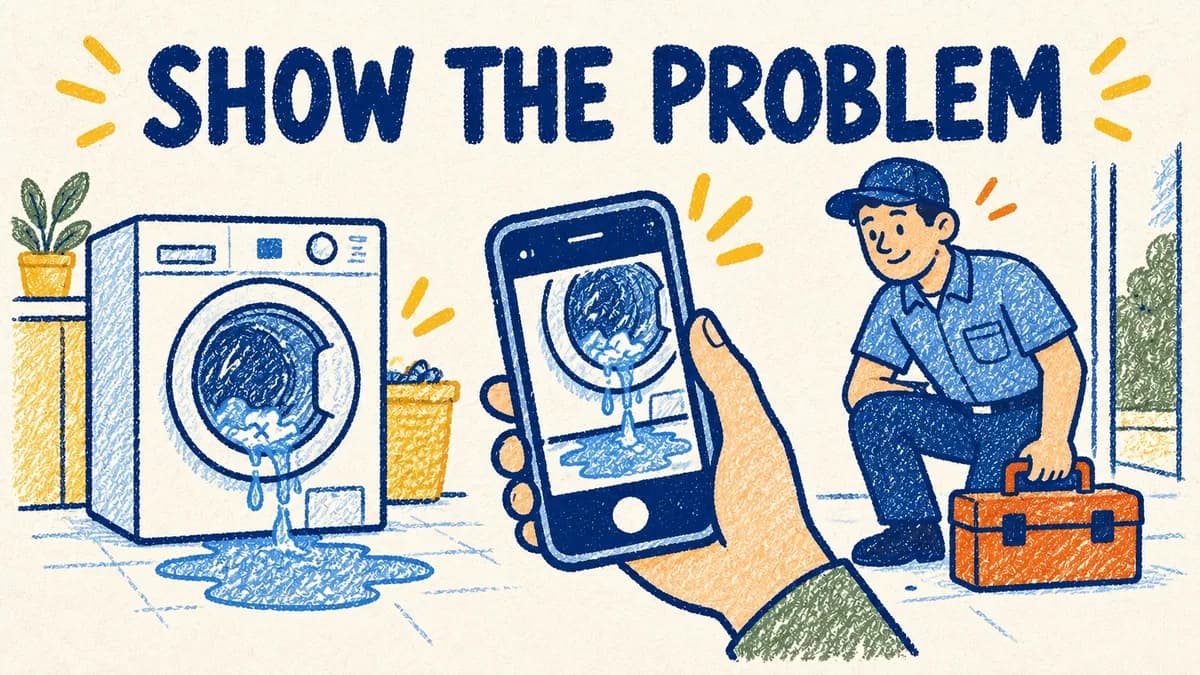
Suppose a homeowner points a phone at a washing machine leaking across the floor and asks, “Who repairs this near me, do they service this model, and can someone come tomorrow?” The customer has supplied a problem, a location-sensitive need, an image and a follow-up question before typing a conventional search phrase.
Google Search Live is built for that kind of interaction. A Canadian local-service business should make its service, coverage, availability and evidence easier to retrieve and verify on the pages and profiles it already owns. A second “voice-search website” would split that information without changing the underlying offer.
There is an important scope note. Google's March announcement says Search Live expanded to every language and location where AI Mode is available. Google's current AI Mode availability page lists Canada. Together, those official sources support Canadian availability. They do not provide Canadian usage, traffic or conversion figures, and Google did not publish a separate September Canada launch in the sources reviewed for this article.
Search Live changed the input, not the need for trustworthy sources
Google describes Search Live as an interactive conversation inside AI Mode. A person can speak, ask follow-up questions, enable the camera for visual context and open supporting web links. The global expansion announcement gives an example of showing Search a shelving unit while asking how to install it.
On September 17, Google updated its Gemini 3.8 Live announcement to say the model was rolling out in Search Live. Google says the model supports visual grounding and more fluid voice interaction. That is a product capability statement. It does not tell an individual business how often it will appear or which page will be linked.
The foundation remains recognizable. Google's guidance for AI features in Search says the usual Search requirements and SEO practices still apply. A page needs to be accessible, indexable and eligible to appear with a snippet. Google does not require special AI schema or a new machine-readable file for these features.
We treat voice and camera as additional ways a customer can express the same task. Improve the source that should answer it before inventing a new page for the interface.
Make three business facts easy to verify
The washing-machine example can be reduced to three decisions. Does this company perform the repair? Does it serve this customer? Is there a credible next step? A local business should answer each one in visible language rather than expecting a logo, generic homepage or list of keywords to carry the meaning.
1. The exact service and its boundary
Name the work a customer can request, common exclusions and any condition that changes the answer. “Appliance repair” is broad. A useful page might identify the appliance types handled, whether the company works on residential or commercial equipment, how estimates are arranged and which work requires another specialist. Do not claim brands, licences or emergency availability that the business cannot support.
2. The real area and time context
Publish the actual service area and current customer-facing hours. A Canadian service-area business does not need to expose a private home address to explain where its team travels. It does need the website and Google Business Profile to agree about the operating model, coverage and contact route.
Google's local ranking guidance recommends complete and accurate business information, including hours, category and relevant attributes. Google describes local results in terms of relevance, distance and prominence. That guidance supports fact maintenance; it does not establish a separate Search Live ranking formula.
3. Evidence and a usable next step
Show what a customer needs to judge fit: an accurate service description, genuine work or location photos where appropriate, credentials that can be verified, the way an estimate or booking works, and a contact action that functions on a phone. If tomorrow's availability changes daily, do not freeze “available tomorrow” into evergreen copy. Explain how the customer can confirm it.
Google says Business Profile information can combine owner-provided details, publicly crawled website content, licensed data, user contributions and Google's interactions with a place. That makes conflict control practical work. Our business information consistency audit shows how to maintain one approved fact packet without forcing identical promotional copy across every channel.
Camera input increases the value of genuine visual evidence
A camera-led question begins with what the customer can see. That does not mean Google has announced a visual-content ranking bonus for local companies. It means the business should consider whether its public evidence helps a person and a search system connect the visible problem to the service being described.
Useful material may include original photos of the work category, equipment, storefront or team process; clear captions; descriptive surrounding copy; and accessible alt text that states what an image shows. A contractor could document the difference between two repair situations. A clinic could show the entrance and accessibility route. A restaurant could keep current interior, menu and service photos. The image should resolve an uncertainty, not decorate a keyword.
Google's Business Profile guidance says photos and videos can show customers what a business offers. Use that feature honestly. Obtain permission for identifiable people, remove private customer information and avoid staging work that the company does not perform. An AI-generated image can illustrate an editorial concept, as the cover of this article does. It should not be presented as operational proof, a completed job or a customer result.
Do not build a separate voice-search website
The tempting shortcut is to publish many conversational pages, repeat “near me” phrases, add question markup everywhere or create a duplicate version of each service for voice. We reject that default.
Start with the page that already owns the customer task. Give it a specific title, a direct explanation of the service, scannable qualifications, visible evidence, a working contact path and crawlable internal links. Keep structured data consistent with what the visitor can see. The same page can support typed, spoken and camera-assisted discovery because the underlying offer has not changed.
A separate asset is justified when the task itself is different. A troubleshooting reference that helps someone identify a visible appliance fault may deserve its own page because it solves a diagnostic job that a service page cannot. “Appliance repair, but written for voice search” does not clear that bar.
This is also where SEO and GEO meet. SEO establishes one eligible, useful source. GEO adds the discipline of making claims self-contained, keeping public facts consistent and checking how an answer surface represents the business. Our SEO-versus-GEO content briefing explains that shared foundation without recommending duplicate platform pages.
Observe one local task without calling it a ranking test
A business can learn from Search Live without turning one conversation into a score. Choose one customer task connected to a real service and write down the conditions before opening the app.
- Freeze the task. Record the spoken question, any object shown to the camera and the follow-up you intend to ask.
- Record the session context. Note the date, location, language, device, account state and whether location or camera access was enabled.
- Capture the observable output. Record the answer's material claims, named businesses and linked sources. Do not collect another person's private data.
- Check the public evidence. Compare important claims with the live service page, Business Profile and contact path. Mark inaccurate, unsupported and unavailable fields separately.
- Choose one owned change. Correct one fact, improve one owner page or leave the content unchanged when the evidence does not support an edit. Repeat later under similar conditions.
This is a sampled observation, not a stable rank. Answers can vary with wording, location, session state, model changes and the information available at that moment. A repeated mention can justify closer inspection; it does not prove market share, causality or lead value.
A Search Live observation answers one question: what did this session return? Search Console and analytics can support separate page and referral reviews, but they do not turn that observation into a record of Search Live impressions or qualified enquiries. The Canadian AI visibility baseline method explains how to keep those records separate.
Turn the observation into one accepted change
After the observation, someone needs to own the correction. We use a short handoff record rather than leaving the answer in a screenshot folder:
- the fixed customer task and test conditions;
- the observed claim, business mention and linked source;
- the public fact or page that agrees, conflicts or remains unavailable;
- the owner responsible for the page, profile or operational fact;
- the smallest supported change and its acceptance check; and
- the later visibility, referral and qualified-enquiry fields to review separately.
A single-location business with accurate pages and profiles can keep this record itself. A focused project becomes more useful when facts conflict across the website and profiles, several services lack clear owner pages, or nobody owns implementation and verification. MAXUOD can inspect the public path, prioritize the first correction, implement or specify it, and document what was actually verified.
Improve the evidence before expanding the experiment
Search Live makes the customer's situation easier to express. It does not remove the need for a business to publish a clear, accurate and useful answer. For most Canadian local businesses, the best first move is to strengthen one existing service path and its public facts, rather than launch a voice-search content cluster.
If you are unsure which page or profile should answer an important customer task, start with the free SEO and GEO audit. For a Canada-wide implementation scope, review our SEO and GEO services for Canadian businesses.
Editorial note: This article reflects MAXUOD Digital's professional interpretation of the official sources checked September 22, 2026. It is educational guidance, not a guarantee of Search Live inclusion, ranking, citation, traffic or enquiries. Google product scope and interfaces can change. Google, Search Live, Gemini and their trademarks belong to Google. No affiliate links are used.
Related reading and sources
Read next on MAXUOD
External references
Which page should answer your customer's real task?
MAXUOD can inspect the public service path, business facts and contact route, then identify the smallest supported SEO or GEO change before you expand the experiment.