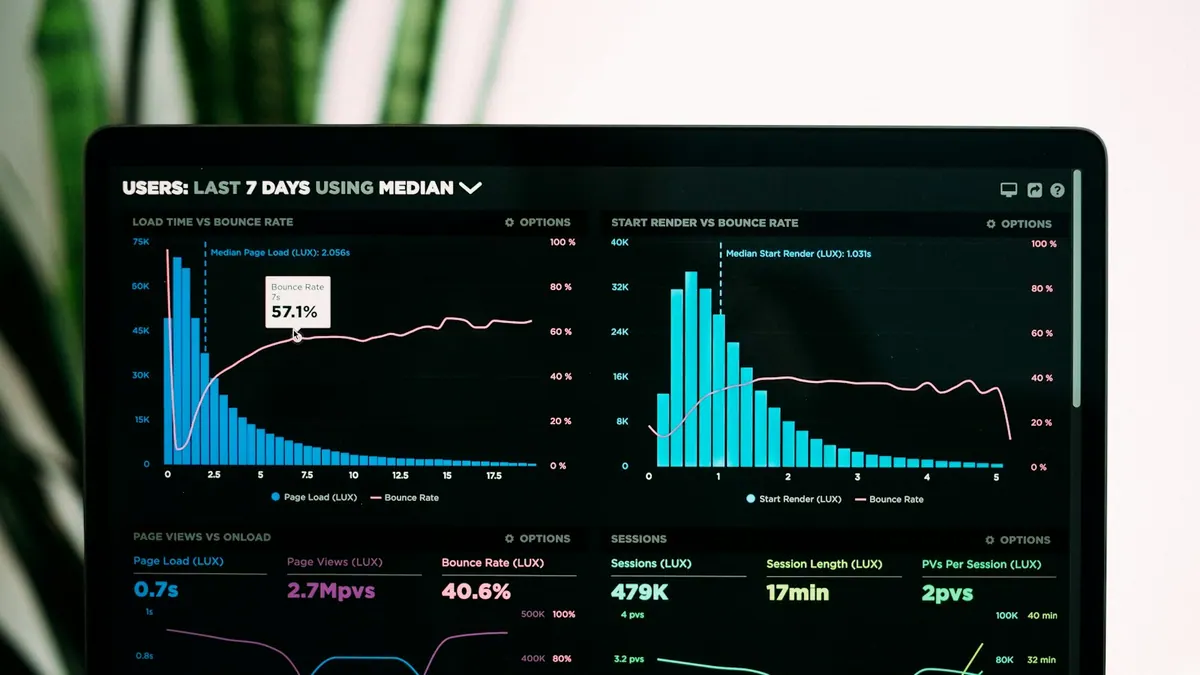
A chart showing less interest in “SEO” is not a reason to abandon a service page that brings in suitable customers. It is a reason to ask what the chart measures—and whether it describes your buyers at all.
Rankability's 2026 research reports a roughly 30% decline in SEO-topic demand after its 2025 peak, using a fixed keyword panel and Google Keyword Planner. That is interest in a topic. It is not a measurement of demand for your service, AI product usage or the share of customers who have left Google.
Keep the dataset smaller than the claim
The report covers 48 months and uses rolling demand comparisons. Its SEO series reached about 33.4 million searches by May 2026. Large aggregate numbers can be useful for observing terminology, but they mix audiences, markets and tasks. A developer looking up an SEO implementation question and a restaurant owner looking for local marketing help may sit in the same broad category.
One possible explanation is that some buyers now use phrases such as AI visibility, AEO or GEO. Another is a change in research demand unrelated to your service. The vendor series cannot distinguish those explanations for a Canadian business. Neither can it show that an enquiry you did not receive moved to ChatGPT.
Start with the questions your customers actually ask
A hypothetical Halifax buyer might ask an assistant, “Who can help my business appear in AI answers?” That is still a visibility problem, but the example is not evidence that Halifax buyers have changed their language. Look for that evidence in your own Search Console queries, enquiry notes and sales conversations.
Separate Canada and the United States if both are target markets. Then review branded and non-branded queries, commercial and informational page groups, and matched periods. A growing query cluster on one relevant service page is more useful for deciding next month's work than a global percentage about the word SEO.
| Signal | Question for your own business |
|---|---|
| SEO-topic demand declines | Are the queries for our actual service and target region declining too? |
| Website clicks decline | Which page/query cohorts changed, and did tracking, indexation or a release change? |
| AI impressions or citations increase | Which source pages and customer tasks are represented, under what reporting scope? |
| Form events increase | Were enquiries delivered, and were more of them suitable for our service? |
| A tool's authority score changes | What changed in the tool's calculation or link data? This is not Google's own quality score. |
SEO still owns the foundation
Google's generative AI optimization guide keeps ordinary SEO practices relevant to its AI features. A useful, eligible page is the shared starting point. There is no need to produce an AI-labelled version of every existing service page.
GEO adds a different review job: how an answer describes the business, whether important facts are accurate, which sources it cites and whether that evidence changes across platforms or test conditions. It does not turn mentions, citations and revenue into one metric. The AI visibility baseline method explains how to keep those observations separate.
Check public facts without inventing a conflict. A company can be based in Halifax and serve Canada online; those statements can both be true. An old phone number, an unsupported office location or contradictory service terms are actual discrepancies. Explain the operating model, then correct the facts that disagree.
Choose the next investment from the missing evidence
If a priority service page has relevant impressions but few visits, inspect its position, query mix and result context before rewriting its title. If visitors arrive but the contact path fails, fix delivery. If the page answers the wrong buyer question, improve that owner rather than adding a near-duplicate blog.
New content is justified when a distinct buyer task is missing. A useful comparison can help someone choose an approach; a how-to can help them complete a process. The format should follow that task, not a requirement to publish a certain number of AI-search articles.
Use Search Console for Google discovery, Bing's report for its supported citation scope, and analytics for recorded website actions. Check qualified enquiries in the actual inbox or CRM. When access or measurement is missing, record unavailable instead of zero. Our small-business reporting guide provides a compact scorecard.
What we would hand back
For MAXUOD, the useful output is a short decision record: the target buyer question, the page that owns it, the observed evidence, the uncertainty and the smallest change worth testing. That might be a service-page correction, a tracking repair, one new article or no content change.
The demand chart earns its place when it prompts that investigation. It does not earn the right to dictate your channel budget or explain a traffic loss on its own.
Buyer questions
Is GEO just a new name for SEO?
For Google Search, Google frames generative AI optimization as part of SEO. Operationally, GEO is useful as a layer for measuring AI mentions, citations, source consistency, and answer accuracy.
Related reading and sources
Read next on MAXUOD
External references
Need a modern SEO and GEO baseline?
MAXUOD can review your rankings, AI-search visibility, priority pages, local profiles, and conversion paths so your reporting reflects how buyers search now.